Machining Pocketed POM Plates Without Warping
Pocketed POM plates warp when the stress inside the sheet lets go unevenly. We machine them in stages, with stress relief between cuts, so the plate stays flat.
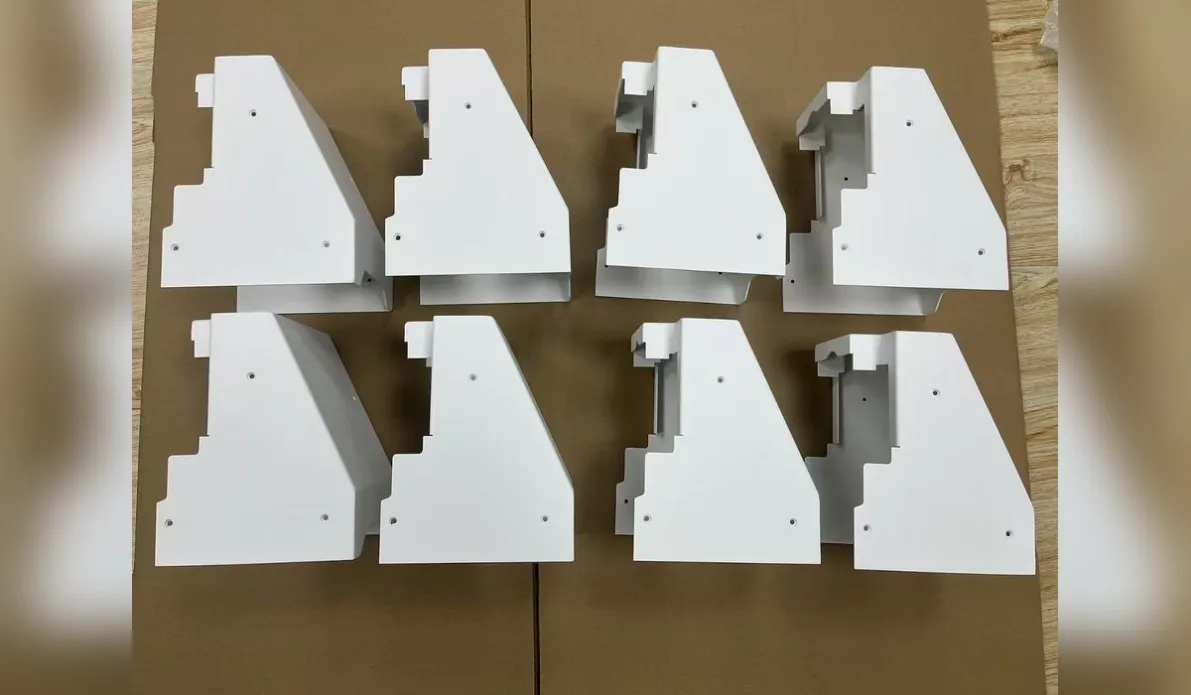
Yes — we machine pocketed POM (acetal) plates: covers, manifolds, nests and base plates with large pockets milled into one or both faces. The part itself is not difficult. Keeping it flat is the job. A POM plate that measures perfectly on the machine can bow overnight if it is cut the wrong way, so the process matters as much as the dimensions. This page explains why these plates move, and how we stop them moving.
Why a pocketed POM plate warps
POM sheet is made by extrusion, and like every extruded plastic it carries stress locked inside it from the day it was made. As long as the sheet stays whole, that stress is balanced and the sheet stays flat. Machining breaks the balance.
A pocketed plate is the worst case. You mill away a large share of the material, often from one face only, and leave a thin floor behind. The stress that the removed material was holding back now lets go — unevenly, because there is more material left on one side than the other. The plate answers by bowing or twisting toward the side that lost the most. The bigger the pocket and the thinner the floor, the stronger the pull.
Heat adds to it. POM does not conduct heat away like aluminum, so a long heavy cut warms the part locally, and warm plastic moves more easily. Neither effect shows up while the part is clamped. It shows up after unclamping, or the next morning — which is why a plate cut in one aggressive pass can pass inspection on the machine and fail it on the bench.
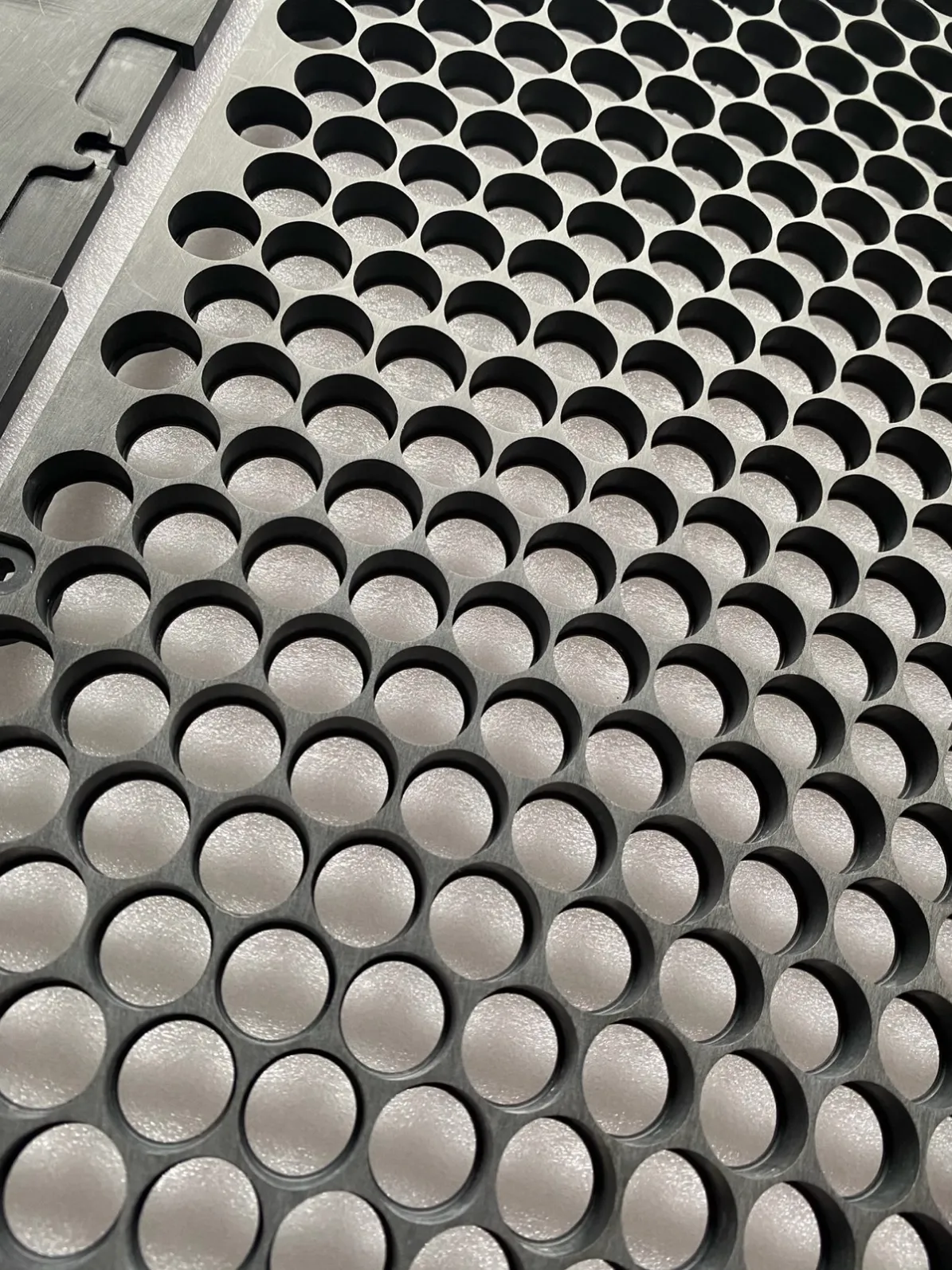
How we machine them: in stages, with stress relief between
The fix is to never let the stress build up a big imbalance in the first place. On a heavily pocketed POM plate, we do not rough it out in one go. The work runs in stages:
- First stage. Rough out part of the pockets, removing material from both faces as evenly as the design allows, and leave a finishing allowance everywhere. The part is still oversize at this point — that is deliberate.
- Stress relief. The roughed plate gets a stress-relief anneal: a controlled heat cycle that lets the locked-in stress relax while the part is still thick enough to hold its shape. (Buyers and material suppliers use both terms — stress relief and annealing — for the same step on plastics.)
- Second stage. Machine the next share of the pockets, again balanced face to face, then stress relieve again if the part is still removing a lot of material.
- Finishing. Only when the stress has had its chances to let go do we take the final cuts — faces, pocket floors, holes and threads — to the finished dimensions.
It is slower than cutting the plate in one pass. It is also the difference between a plate that is flat when it leaves and a plate that is flat when it arrives. For most plastic parts this staging is unnecessary — a solid POM block or a lightly machined plate machines in one setup without drama, as covered in our article on machining PEEK, Ultem and PTFE. It is the large-area, one-sided removal on thin plates that earns the extra steps.
Design choices that make flatness easier
Some of the battle is won on the drawing:
- Keep pockets symmetric. Pockets mirrored across the plate, or balanced between the two faces, release stress evenly. One deep pocket on one face is the hardest layout to hold flat.
- Keep the floor thickness even. A floor that steps between thick and thin areas moves unevenly. One consistent floor thickness behaves far better.
- Use generous corner radii. Sharp internal corners concentrate stress in plastic. A radius is kinder to the part and easier to machine.
- Do not chase metal tolerances on a plastic plate. POM plates are held to ±0.1 mm (±0.004") as standard. A flatness or tolerance callout tighter than the material can honestly hold buys scrap, not accuracy — if a face genuinely needs to be flatter, tell us which face and why, and we will plan the staging around it.
Material choice plays a part too: POM is one of the better-behaved plastics for this — it absorbs little moisture and machines cleanly — which is why it is the usual pick for plates like these. The wider comparison is in our CNC machining materials guide.
How flatness is checked
Flatness is checked on the finished plate, off the machine, after the part has had time to settle — checking a plate straight off the finishing pass, still warm and freshly unclamped, tells you less than checking it the way the customer will receive it. Critical dimensions are recorded against the drawing, and a first article inspection report, material certificate and certificate of conformance can travel with the shipment on request.
What to send for a quote
The drawing or model, the POM grade if you have one specified, the quantity, and — if flatness is the critical feature — a note saying so, with the flatness value you need. We will quote the staged process honestly rather than quote a one-pass price and ship a banana. Send it via our contact page — enquiries are answered within 8 hours and quotes usually come back within 24 hours.
FAQ
Why did my last supplier's POM plates arrive bowed? Most likely they were roughed out in one pass. Removing a lot of material from one face releases the sheet's internal stress unevenly, and the plate bows after unclamping. It is a process problem, not a material defect.
What does the stress-relief anneal do? It lets the stress locked in the plastic relax in a controlled way, between machining stages, while the part still has enough material to hold its shape. After the anneal, the next cuts are made in settled material.
Can you hold a tight flatness on a large pocketed plate? Within what POM can honestly do, yes — the staged process exists for exactly that. Tell us the flatness value and which face matters at quote stage, and we will confirm whether it is achievable before you order.
Does staging make the parts slow or expensive? It adds process steps, so a pocketed plate costs more than the same plate quoted as a one-pass job. Small batches still typically run in days, not weeks. What it removes is the far more expensive outcome: a batch of plates that all bow the same way.
Would another plastic stay flatter than POM? For large pocketed plates POM is already one of the better choices — stable, low moisture uptake, clean machining. The process matters more than swapping materials; a badly staged plate warps in almost any plastic.