Machining PEEK, Ultem and PTFE
Machining PEEK, PTFE and other engineering plastics: heat, stress, burrs and realistic tolerances — what changes when the material is not metal.
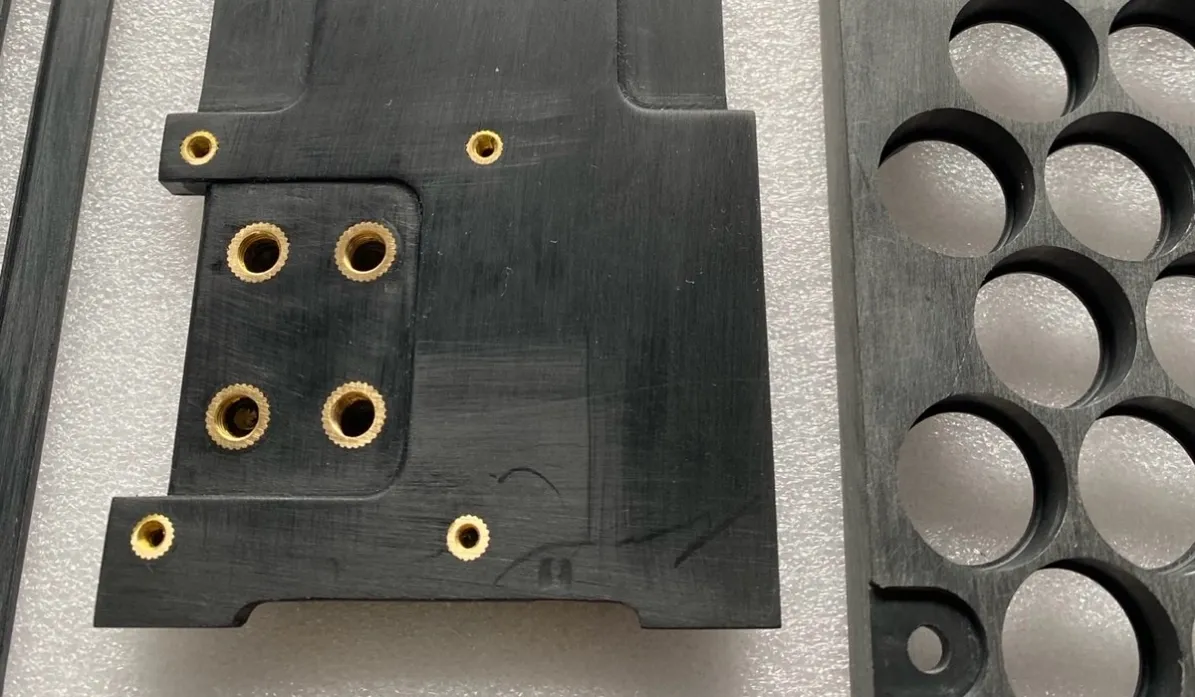
Engineering plastics are not soft metals. They expand with heat several times faster than aluminum, they spring away from the cutter instead of shearing cleanly, and they remember the stresses frozen into the stock. PEEK, Ultem (PEI), PTFE, POM, nylon, PC and ABS are all machined here regularly — PEEK, Ultem and PTFE most often for semiconductor equipment and lab instrument parts — and this page covers the four things that decide whether a plastic part comes out to size: heat, stress, burrs and honest tolerances.
Heat: the dimension you measure is the temperature you measure it at
Plastics grow with temperature far more than metals do, and cutting generates heat exactly where the dimension matters. A PEEK bore measured warm at the machine can close up measurably as it cools on the inspection bench. The working habits follow from that: sharp tooling that cuts rather than rubs, feeds that keep the chip carrying heat away, coolant or air blast where the material allows it, and critical dimensions verified after the part has settled to room temperature. The same physics applies in service — a plastic part specified at ±0.01 mm (±0.0004") across a wide temperature range is a design conversation, and it happens at quote stage, not after the parts move in the customer's assembly.
Stress: anneal before the final cut
Extruded and molded plastic stock carries internal stress. Machine one side of a stressed blank and it bows as the stress rebalances — the plastic equivalent of a metal plate warping, except it can keep moving for days. For precision PEEK, Ultem and similar parts, the answer is a stress-relief cycle: rough the part close to size, anneal it to let the stress out, then take the finishing cuts on a stable blank. It adds a step and it is the difference between a part that measures flat on Friday and one that still measures flat when it reaches the customer. (This is plastic stress relief, standard practice for precision polymer parts — a different subject from surface finishing.)
Burrs: plastic does not deburr like metal
A metal burr snaps or files off. A plastic burr stretches, smears, or melts back onto the edge. Burr control in plastics starts at the cutter — sharp, polished flutes and the right geometry leave a cleaner edge than any amount of handwork — and finishes with careful manual deburring, because tumbling and aggressive media can round edges the drawing wanted sharp or embed media in a soft surface. Sealing faces and O-ring grooves get particular attention: a smeared burr across a groove is a leak with good paperwork. If an edge must be absolutely clean — a fluid path, an optical housing — say so on the drawing and it is planned as a requirement, not left as a hope.
Tolerances: what is realistic in plastic
Plastics can be machined accurately, and pretending they behave like steel helps nobody. In PEEK, Ultem and the stable engineering plastics, ±0.05 mm (±0.002") is a sensible precision target for well-designed features, with ±0.025 mm (±0.001") achievable on selected dimensions that are fixtured, annealed and measured at temperature — the achievable figure for your geometry is confirmed at quote stage. Softer, more mobile materials (PTFE is the extreme: it creeps, it is slippery, and it moves if you look at it) are quoted feature by feature. Features that help: short, supported dimensions; symmetric walls; and avoiding a tight tolerance that spans a long, thin section. Our materials guide covers where each plastic sits; transparent work is a separate subject, covered in our piece on vapor-polished clear parts.
Holding the work without marking it
Plastic parts mark if you clamp them like metal, and distort if you clamp them hard enough to feel safe. Soft jaws machined to the part's profile, vacuum fixtures for plates, and support under thin sections are the standard answers. The part that comes off the machine should look like the part on the drawing — including no jaw marks across a cosmetic face.
Send the drawing through our contact page with the material grade stated — grade matters in plastics as much as in metal. We respond within 8 hours and normally quote within 24 hours, with the tolerance conversation included where the material needs one.
FAQ
Can you hold tight tolerances in PEEK? Yes, with the process built for it: rough, stress-relieve, finish, and measure at room temperature. ±0.05 mm (±0.002") is a sound precision target; tighter is possible on selected features and is confirmed per geometry at quote stage.
Why do plastic parts warp after machining? Internal stress in the stock rebalances as material is removed. Annealing between roughing and finishing lets the stress out before the final dimensions are cut.
Is PTFE machinable to precision? Within its nature: PTFE creeps and moves with temperature, so tolerances are quoted feature by feature. It is excellent for seals, seats and insulators where its softness is the point.
Which engineering plastics do you machine? PEEK, Ultem (PEI — in black and in its natural amber), PTFE, POM, nylon, PC, ABS and acrylic are regular work, plus carbon-fiber composites. The grade is sourced against your specification.
How are burrs handled on plastic parts? At the cutter first — sharp, polished tooling — then careful hand finishing. Sealing faces and grooves are checked specifically, because a smeared burr there becomes a leak.