Carbon and Alloy Steels Compared: 1018, C45, 4140, A2
1018, C45, 4140 or A2? How the four common carbon and alloy steels differ in strength, hardening and cost — and which one fits your machined part.
Stainless gets the attention, but a large share of the steel parts we machine are plain carbon and alloy steels — chosen not for corrosion resistance but for strength, hardness, and price. Four grades cover most of what lands on our desk: 1018, C45, 4140, and A2. They are not interchangeable. The short version: pick 1018 for cheap, easy, unstressed parts; C45 when a shaft needs some hardness; 4140 when the part has to be strong all the way through; and A2 when the surface has to resist wear like a tool.
1018 and C45: The Everyday Carbon Steels
1018 is a low-carbon steel (about 0.18% carbon). It machines easily, welds without drama, and costs the least of the four. What it will not do is harden: with so little carbon, through-hardening is off the table, so 1018 parts stay relatively soft. That is fine for brackets, spacers, mounting plates, fixture parts, and shafts that carry alignment rather than load. If the surface needs wear resistance, 1018 can be case hardened (carburized) — a hard skin over a soft core — but if you know the part needs hardness, starting with a higher-carbon grade is usually simpler.
C45 (the EN grade, roughly AISI 1045) is the medium-carbon step up, at about 0.45% carbon. It is still easy to machine and still economical, but now heat treatment works: C45 can be hardened and tempered, and it responds well to induction or flame hardening, so a shaft can get a hard surface on the journals while the core stays tough. That combination — cheap, machinable, hardenable — is why C45/1045 is the default shaft material in half the machinery on earth. Its limits: hardenability is shallow, so thick sections won't harden deeply, and welding needs more care than 1018 (preheat on heavier sections).
4140: The Strength Grade
4140 is a chromium-molybdenum alloy steel (about 0.40% carbon, with roughly 1% chromium and 0.2% molybdenum). The alloying buys hardenability: 4140 can be quenched and tempered to a useful combination of strength and toughness through real section thicknesses, not just at the skin.
Most 4140 parts are machined from pre-hardened stock — material already quenched and tempered, commonly around 28–32 HRC. At that hardness it machines perfectly well with carbide tooling, just slower and with more tool wear than 1018, and the part comes off the machine already at its working strength: no heat-treatment distortion afterwards, no straightening, no second setup. For highly stressed shafts, gears, bolts, hydraulic and drivetrain parts, that is the standard route. If higher hardness is needed, 4140 can also be induction hardened or nitrided on the surface.
The trade-offs are price and welding. 4140 costs more than carbon steel, and welding it properly means preheat and controlled cooling — tell us about welds at quote stage rather than discovering them later.
A2: The Wear Grade
A2 is an air-hardening tool steel — about 1% carbon and 5% chromium. It belongs to a different family from the other three: it is made for punches, dies, shear blades, forming tools, and wear parts that have to hold an edge or a precise face through a long working life.
The workflow is different too. A2 is machined in its soft, annealed condition, then hardened — and because it hardens in air rather than needing an oil or water quench, it moves very little during heat treatment, which is why it is the default choice for precise tooling. After hardening to typically 57–62 HRC, the part is finish-ground (and EDM'd where the shape needs it) to final size. That extra processing is the cost of the performance: an A2 part costs more than the same shape in 4140, and it should — it will outlast it many times over in a wear application. In return, don't ask A2 to be a structural material: it is hard and wear-resistant, not tough in the 4140 sense, and it is not a weldable grade.
Side by Side
| Grade | Type | Carbon | Heat treatment | Pick it for |
|---|---|---|---|---|
| 1018 | Low-carbon steel | ~0.18% | Case hardening only | Brackets, spacers, plates, low-stress shafts |
| C45 (≈1045) | Medium-carbon steel | ~0.45% | Harden & temper; induction hardening | General shafts, gears, parts needing a hard surface |
| 4140 | Cr-Mo alloy steel | ~0.40% | Quench & temper through-section; usually machined pre-hardened | High-strength shafts, gears, stressed machine parts |
| A2 | Air-hardening tool steel | ~1.0% | Air hardening to ~57–62 HRC, finish ground | Punches, dies, blades, wear parts |
Finishing Steel Parts: Black Oxide First
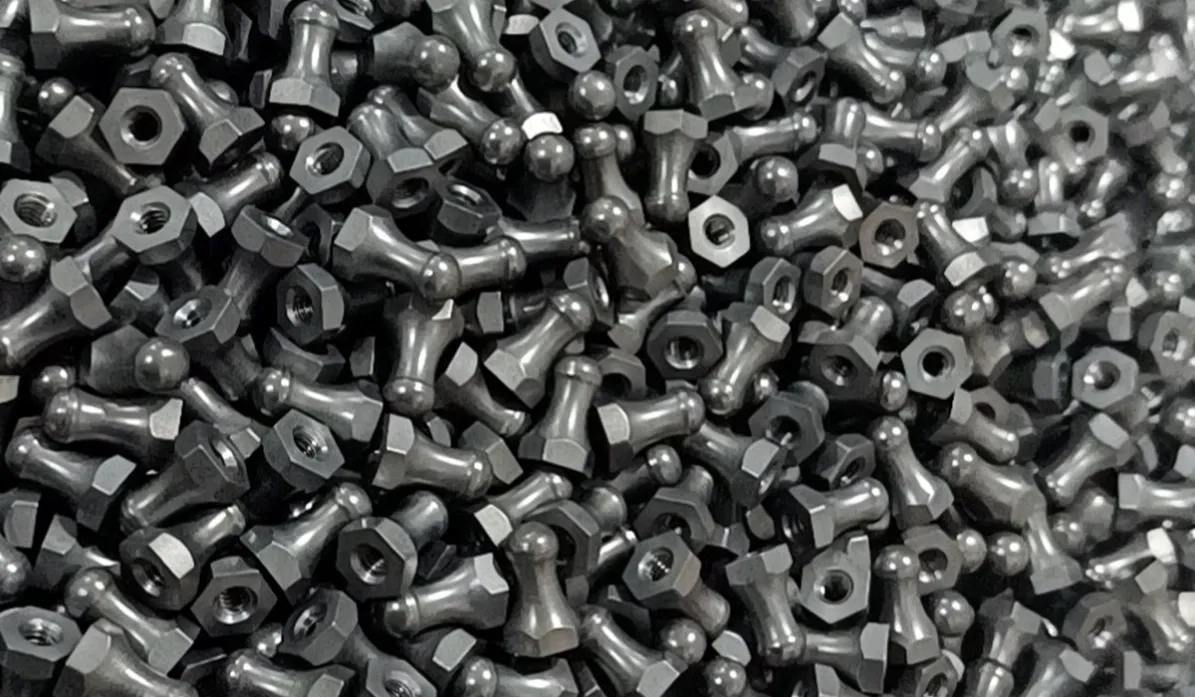
None of these four is stainless, so corrosion protection has to come from the finish. Our default for steel parts is black oxide — a thin conversion coating that turns the surface black, adds mild corrosion resistance, and changes dimensions by essentially nothing, which is why it suits precision parts. It is the finish on most of the steel parts we ship; we compared it with the other black options in our article on black finishes compared, and it is the standard finish on the batch turned parts we produce.
When a steel part needs real corrosion protection rather than a cosmetic black, the honest options are plating (zinc, nickel), powder coating, or changing the material to stainless — black oxide alone won't survive a wet environment, and we'd rather say that at quote stage than have a part rust in service.
Carbon Steel or Stainless?
The split is simple. If the part lives indoors, is painted, oiled, black-oxided, or just doesn't meet water and chemicals, carbon or alloy steel usually wins on strength per dollar — and 4140 at working hardness will outperform most stainless grades mechanically. If the part faces moisture, washdown, food, medical, or outdoor exposure, stainless earns its price; our stainless grades compared article walks through that family. The mistake we see on drawings is paying for stainless where black-oxided 4140 would do the job better and cheaper — or the reverse, carbon steel specified into a wet environment to save money that rust will collect later.
FAQ
Can 1018 be hardened? Not through-hardened — there isn't enough carbon. It can be case hardened (carburized) for a wear-resistant skin. If the part needs hardness through its section, step up to C45 or 4140.
Is C45 the same as 1045? Effectively yes for machined parts: C45 is the EN designation, 1045 the AISI/SAE one, with closely matching composition. Either callout on a drawing works; we machine to the same material.
Why machine 4140 in the pre-hardened state? Because the part then needs no heat treatment after machining — no distortion, no straightening, and the strength is already there. At 28–32 HRC it still machines well with carbide tooling.
When is A2 worth its extra cost? When the part's job is wear: punches, dies, blades, guides, and forming tools. A2's air-hardening stability also makes it the safer choice for precise tooling that must hold size through heat treatment.
What finish do steel parts get if the drawing doesn't say? Ask us before production, not after. Our default recommendation for indoor steel parts is black oxide; for anything exposed to moisture we'll suggest plating, coating, or stainless instead.
Working on a steel part and not sure which grade the drawing should call out? Send the drawing through our contact form — tell us what the part has to survive, and we'll confirm the grade and finish with the quote, usually within 24 hours.