Small Turned Parts in Batches: Consistency, and Why Black Oxide Suits Them
Two thousand small turned parts have to be right two thousand times. Batch consistency on 440C pins and studs, and why black oxide suits small steel parts.
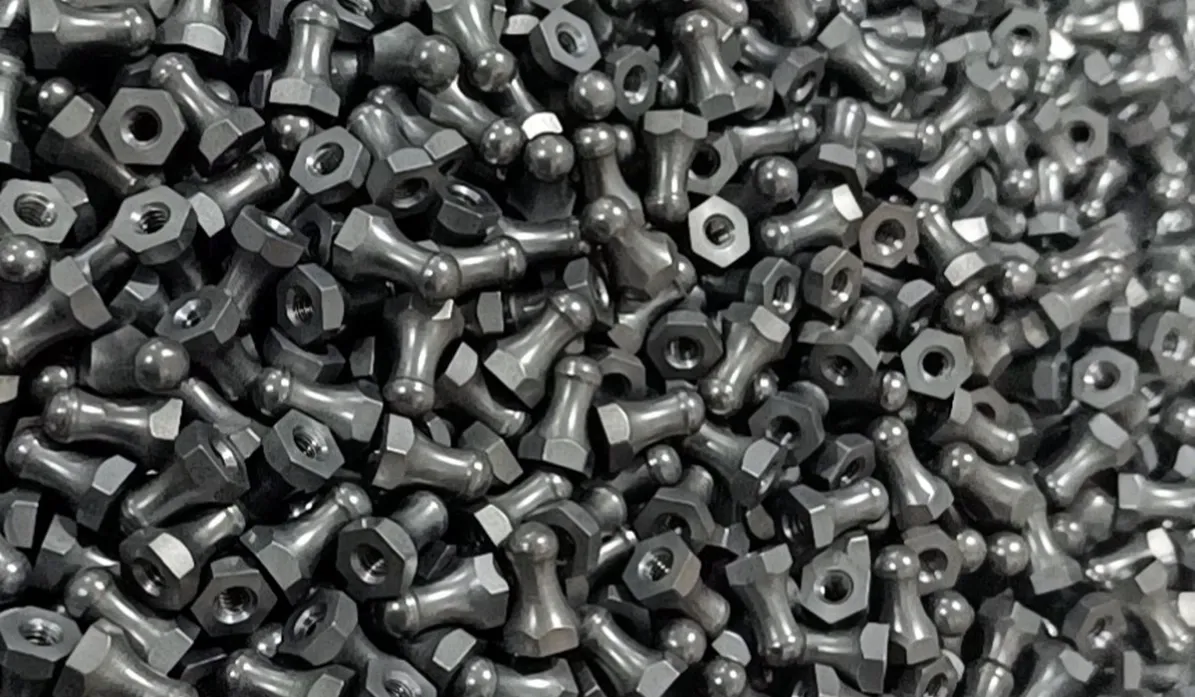
Small parts are deceptive. A ball-end pin or a hex-headed stud that fits in a teaspoon still has a diameter, a thread, a ball radius, and a finish that all have to be right — and when the order is for two thousand of them, they have to be right two thousand times in a row.
The black parts in the photo are a good example: small 440C stainless steel components with a ball end and a hex, finished with black oxide. Here's how a batch like this runs, and why that finish is a smart match for small precision parts.
One Setup, Bar-Fed, Minimal Handling
The cheapest way to make a small turned part accurately is to touch it as little as possible. Parts like these run from bar stock on the lathe: the bar feeds through the spindle, the part is turned, threaded, and parted off in a single setup, and the next one starts. No re-chucking means no second chance to introduce error — the ball end stays concentric with the thread because both were cut in the same grip.
For a batch, the work is in the discipline around the machine:
- First-article check before the run. The first parts off are measured fully — that's what an FAI is for — and the run only starts once they match the drawing.
- In-process checks at intervals. Tools wear, and on small parts a worn insert shows up as a drifting diameter or a rough finish long before it shows up as scrap. Checking a sample every set interval catches drift while it's still a tool change, not a rejected batch.
- Tolerances where they belong. Our standard turning tolerance is ±0.1 mm, and ±0.01 mm is achievable on the features that need it — a press fit, a thread, a locating diameter. Holding the tight numbers on the features that matter, and only those, keeps a batch economical. (More on that logic in our article on CNC tolerances.)
Why 440C for a Part Like This
440C is the hardenable grade of stainless steel. After heat treatment it reaches hardness levels the common 300-series grades can't, which makes it the go-to stainless for small parts that see wear — ball ends, detents, valve components, wear pins — while still offering real corrosion resistance. It machines differently from 304 or 316 and rewards a shop that has run it before: feeds, tooling, and the order of operations around heat treatment all matter.
Black Oxide: A Finish That Adds Nothing — on Purpose
Black oxide (blackening) is a conversion finish: it reacts with the surface of the steel rather than coating it. That gives it three properties that suit small precision parts unusually well:
- Essentially no thickness. Unlike paint, powder coating, or plating, black oxide adds no measurable dimension. A thread that gauged correctly before finishing still gauges correctly after; a ±0.01 mm feature stays a ±0.01 mm feature. On small parts with tight fits, that alone can settle the finish choice.
- A uniform matte black look that doesn't chip or flake, because there's no coating layer to chip.
- Mild corrosion protection. On its own, black oxide offers modest rust resistance, helped by the oil or wax seal applied after the process. It's honest protection for indoor and lightly exposed service — not a substitute for plating or passivation in harsh environments, and we won't pretend otherwise.
For hardened 440C parts that need to look black, resist everyday corrosion, and assemble exactly as machined, it's a combination that's hard to beat.
Small Parts, Shipped Like They Matter
The last step is unglamorous and important: small parts get separated, protected, and packed so two thousand ball ends arrive as two thousand good ball ends, not a bag of parts that have been denting each other in transit.
If you have a small turned part headed for batch production, send the drawing via our CNC turning page. Prototypes typically ship in 3–5 days, quotes come back within 24 hours, and FAI reports, material certificates, and a certificate of conformance are available on request. NDAs are no problem.