Thread Callouts: UNC/UNF vs Metric Threads
How to read and write thread callouts: UNC/UNF vs metric coarse and fine, thread classes 2B and 6H, depth callouts, and the mistakes that stall quotes.
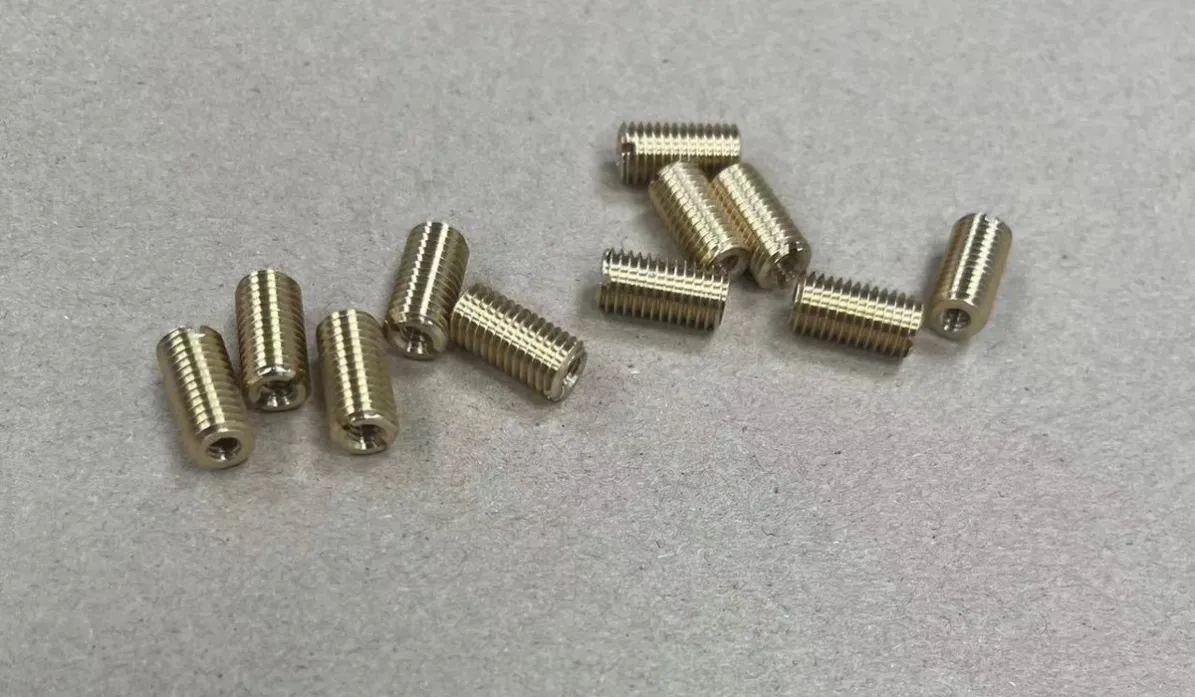
More quote delays are caused by thread callouts than by almost anything else on a drawing — not because threads are difficult, but because a callout that is obvious to the person who wrote it can be genuinely ambiguous to the person who has to cut it. We work in both thread systems daily: American drawings arrive with UNC and UNF callouts, European drawings with metric, and many assemblies mix the two. This page is the reference we wish every drawing followed: what a complete callout contains, what the classes mean, and the handful of mistakes that reliably generate an email before they generate a part.
The two systems, side by side
Unified (UNC/UNF) sizes are given as a diameter (a number size, a fraction, or a decimal) followed by threads per inch: 1/4-20 is a quarter-inch thread with 20 threads per inch. The series letter says how fine it is — UNC coarse, UNF fine, UNEF extra fine. A 1/4-20 is UNC; a 1/4-28 is UNF.
Metric sizes are given as M plus the diameter in millimetres, followed by the pitch — the distance between threads, also in millimetres: M6 × 1 is a 6 mm thread advancing 1 mm per turn. Metric also has coarse and fine series, but the pitch is always a length, never a count: M6 × 0.75 is the fine version. The single most common cross-system confusion is reading a metric pitch as threads-per-inch or the reverse — which is why a complete callout always names its system unambiguously. Metric coarse threads are often called out without the pitch (M6 means M6 × 1); fine threads must state it (M6 × 0.75).
The class: the part of the callout that gets forgotten
Diameter and pitch define the thread's geometry; the class defines how tightly it must fit. Unified internal threads are usually class 2B (1B is loose, 3B is tight); external threads are 2A to match. Metric internal threads are usually 6H; external, 6g. Most drawings that omit the class intend the standard fit — 2B/6H — and that is the assumption we quote on, stated in the quote so it can be corrected if it is wrong. If your assembly needs a specific fit — a thread that must not loosen, a gauge-tight location — write the class. It is one short string that removes a whole category of surprise.
Depth and through: the second forgotten item
A tapped hole callout needs its depth: the usable thread depth, and whether the hole goes through. "M6 × 1 - 6H, 12 deep" and "1/4-20 UNC-2B THRU" are complete; "M6 tap" is a question waiting to happen. Remember that a tap cannot thread to the bottom of a blind hole — the drill point and the tap's chamfer need room beyond the usable thread, so a drawing that demands full thread to the very bottom of a blind hole is asking for a thread-milling or a design change, and it will be flagged at quote stage rather than silently short-threaded. Our piece on 316 stainless fittings shows how much rides on these details where threads also have to seal.
How threads are verified
Cut threads are checked with go/no-go thread gauges in the class specified — the go gauge must enter, the no-go must not. That is the inspection your drawing's class buys you: not a visual opinion, a gauged fit. Where a thread is a sealing thread — NPT and other taper pipe threads are the common case — say so explicitly; a taper thread is not a straight thread with ambitions, and substituting one for the other is a leak.
The five mistakes that stall a quote
- No class — quoted as standard fit (2B/6H), confirmed in the quote, but a round of email if it mattered.
- No depth on a blind hole — the one dimension we cannot guess.
- Full thread demanded to a blind hole's bottom — physically unavailable from a tap; needs thread milling or a deeper hole.
- Mixed systems without a flag — a metric thread on an inch drawing (or the reverse) that is actually intentional: fine, we make it as drawn, but it is confirmed at quote stage because it is also what a typo looks like.
- A thread named by its fastener — "thread for a #8 screw" is not a callout; the thread itself (8-32 UNC-2B) is.
What we do with all this
Threads are made exactly as called out — UNC, UNF and metric in their specified classes, gauged as such, with no metric substitutions for imperial callouts or the reverse, as our inch drawing guide sets out. Incomplete callouts are completed by the standard assumptions above and restated in the quote for your confirmation. And if a thread on your drawing cannot be made as drawn, the manufacturability check says so before money moves — that is what it is for, as our tolerances guide explains in the adjacent context of fits.
Send drawings through our contact page. Complete thread callouts are the fastest single upgrade you can make to quote speed — we respond within 8 hours and normally quote within 24 hours either way.
FAQ
What is the difference between UNC and UNF? Pitch. For a given diameter, UNC is the coarse series and UNF the fine series — a 1/4-20 (UNC) has 20 threads per inch; a 1/4-28 (UNF) has 28. Fine threads give finer adjustment and better resistance to loosening; coarse threads assemble faster and tolerate damage better.
What do 2B and 6H mean? They are fit classes: 2B is the standard Unified internal-thread class, 6H the standard metric internal-thread class. Together with diameter and pitch they define the thread completely, and they are what the go/no-go gauges check.
My drawing doesn't state a thread class. What happens? We quote on the standard fit for the system (2B for Unified, 6H for metric) and state that assumption in the quote, so you can correct it before production if your assembly needs something else.
Can a blind hole be threaded to the very bottom? Not with a tap — the tap's chamfer and the drill point need space beyond the usable thread. If full-depth thread is essential, thread milling can get closer; the requirement should be flagged on the drawing and will be discussed at quote stage.
Do you make NPT pipe threads? Yes, when the drawing calls them out as taper pipe threads. They are made and gauged as NPT — never substituted with a straight thread.