Titanium Grade 5: A Machining Case Study
A titanium Grade 5 pin, turned and milled: holding a slender shaft straight, forming the domed head, and finishing a metal that punishes dull tools.
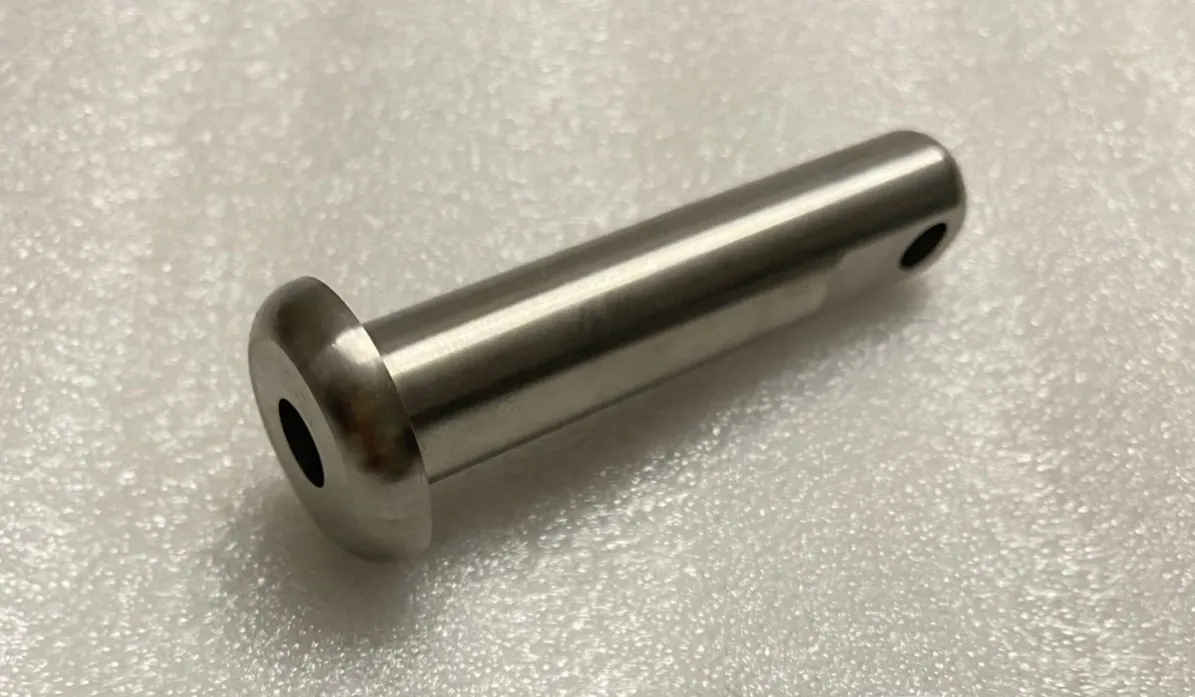
Some parts explain a material better than a lecture does. This is a pin in titanium Grade 5 (Ti-6Al-4V): a long, slender shaft with a domed head, turned and milled, supplied as-machined with no coating. Our titanium machining guide covers why titanium is slow in general. This page is narrower: what this one part demanded, and how it was made.
The part
A pin is a simple drawing with nowhere to hide. The shaft is long relative to its diameter, the head is a smooth dome rather than a flat or a hex, and the whole part is one piece — head and shaft in a single blank of Grade 5. Parts like this appear across medical and laboratory instruments and precision equipment generally: anywhere a locating or pivot element needs titanium's strength and corrosion resistance at a fraction of steel's weight. The application is the customer's business; the geometry is ours.
Difficulty one: a slender shaft wants to bend
Turn a long, thin shaft and it deflects away from the tool — the middle of the shaft ends up heavier than the ends, and the part comes off the machine barrel-shaped. Titanium adds its own twist: it is springy, and it conducts heat poorly, so the cutting zone runs hot while the part pushes back. The countermeasures are support and sequence: the shaft is turned with the workpiece supported along its length, cuts are balanced so no section is finished while its neighbor is still heavy, and final sizing passes run the full length at a consistent light cut. The result is checked as a shaft should be — diameter at several stations along the length, not one measurement at the end.
Difficulty two: the dome is a form, not a feature
The rounded head is not a chamfer or a radius added at the end; it is a continuous form that has to blend into the shaft without a step or a flat. It is cut as a profile — the toolpath follows the curve — and then verified against the drawing's profile rather than eyeballed. A dome that is slightly off-form announces itself immediately in the hand and in the photograph; there is no hiding behind a tolerance block.
Difficulty three: titanium punishes dull tools, visibly
Grade 5 work-hardens and galls. The moment a cutting edge dulls, the surface stops shearing and starts tearing, and the finish shows it — and on an uncoated part like this one, the machined surface is the delivered surface. Tool condition is therefore treated as a process parameter: edges are changed on schedule rather than on failure, cutting speeds stay in the range where the material shears, and the finishing pass runs with a fresh edge. The surface you see in the photograph is the surface the process was built to leave.
Inspection and delivery
The finished pins are inspected on the dimensions the drawing controls — shaft diameter along its length, head profile, overall length, and the concentricity of head to shaft — and packed so the shafts cannot fret against each other in transit. Small parts, long parts and finished surfaces each have their own packing logic; the principle is the one in our packing practice: the part that arrives is the part that was inspected.
If your part is titanium because the application demands it — weight, corrosion, temperature — send the drawing through our contact page. Grade 5 is the common callout; Grade 2 is also machined where its corrosion resistance matters more than strength. We respond within 8 hours and normally quote within 24 hours, and if a hard steel or a coated part would do the same job faster, the quote will say so.
FAQ
Why is the part made in one piece instead of assembled? A one-piece pin keeps the head and shaft perfectly concentric and removes a joint that could loosen in service. It costs more machining time; for a locating element, it is usually the right trade.
Can titanium parts be supplied uncoated? Yes — this part ships as-machined. Titanium's own oxide film gives it excellent corrosion resistance without any applied coating.
How do you keep a long titanium shaft straight? Support along the length during turning, balanced cutting sequences, and light full-length finishing passes — verified by measuring the diameter at several stations, not just at the ends.
Do you machine titanium Grade 2 as well as Grade 5? Yes. Grade 5 is specified for strength; Grade 2 for maximum corrosion resistance and formability. The quote works to whichever grade your drawing states.
What tolerances apply to a part like this? The drawing's tolerances govern: ±0.1 mm (±0.004") as our standard, ±0.01 mm (±0.0004") available on the features that need it, confirmed for the geometry at quote stage — see our tolerances guide.