Handling Bead-Blasted Aluminum Parts Without Leaving Marks
A bead-blasted finish with no anodize over it is bare aluminum, and bare aluminum records every fingerprint. Why the marks happen, and how the parts should be handled.
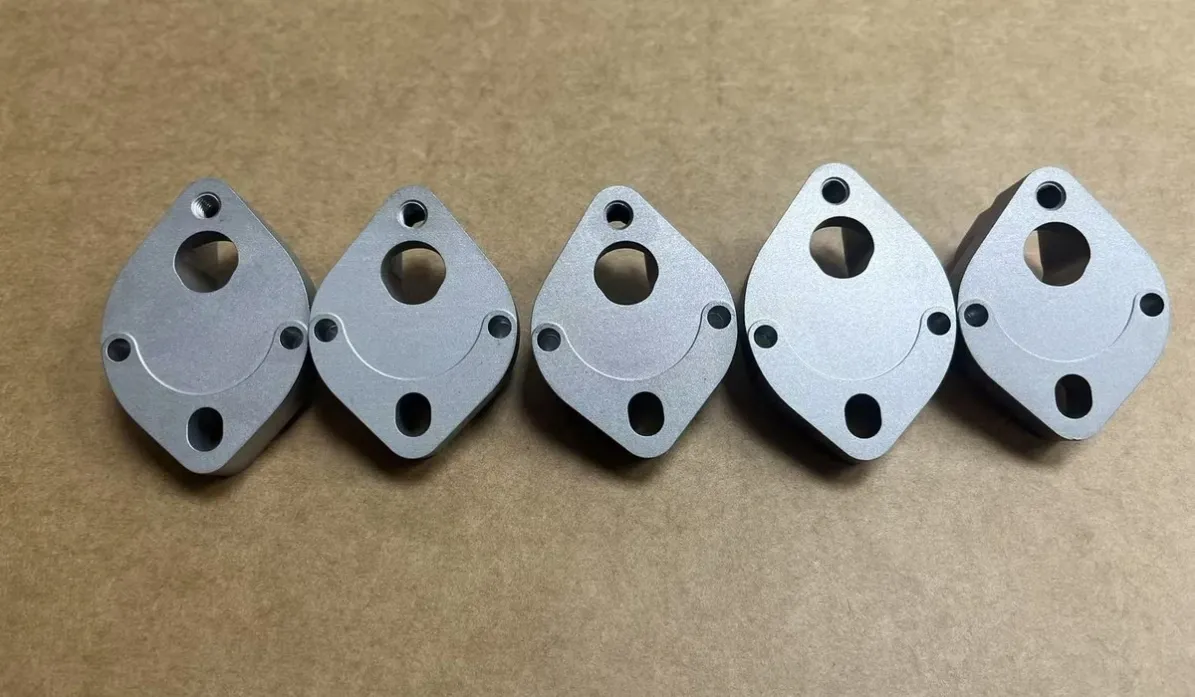
A bead-blasted aluminum part with no anodizing over the top looks forgiving — matte, even, no shine to spoil. It is actually one of the easiest finishes to ruin with a bare hand. One fingerprint pressed onto it during inspection can still be there, visible, when the part is installed. This page explains why blasted-only parts mark so easily, how we handle them so they leave here clean, and how to handle them at your end so they stay that way.
Why bare blasted aluminum records every touch
Bead blasting peens the surface with fine glass beads and leaves a uniform matte texture — thousands of tiny dents, no direction, no polish. On an anodized part, that texture sits under a hard oxide layer that seals the metal away from the world. On a blasted-only part there is no layer. The texture is bare aluminum, and bare aluminum is reactive and slightly soft.
A fingertip carries sweat and skin oil — water, salts and mild acids. Press it onto bare blasted aluminum and two things happen. The oil fills the tiny dents in the texture, which changes how that spot reflects light, so the print shows as a darker or glossier patch against the matte field. And the salts start a faint surface reaction in the outline of the print. The first effect is optical, the second is chemical, and together they make a fingerprint that a dry cloth will not simply wipe away — wiping tends to smear the oil further into the texture. On a mirror finish a fingerprint sits on the surface; on bare blasted aluminum it moves in.
This is also why the marks always seem to appear in the worst place. The finish is perfectly uniform, so anything that is not uniform — a print, a glove smear, a water spot — is the first thing the eye finds.
How we handle them here
The rule on our side is simple: once a part has been blasted, bare hands do not touch it again.
- Gloves for every contact after blasting. Machining unload, deburring checks, dimensional inspection, counting, packing — all of it is done gloved. The part is treated as finished from the moment it comes out of the blast cabinet.
- Cleaning before packing. Parts are ultrasonically cleaned so cutting oil and shop dust are gone before they are wrapped, not sealed in with the part.
- Packing that keeps hands off. Parts are packed separated so faces cannot rub, and clean packing — double-bagging, vacuum sealing, labels on the outside of the bag — is available where the parts are going into a clean assembly area, the same options described in our packing guide.
Most of the blasted parts we ship are blasted as preparation for anodizing, which seals the surface — our article on why we bead blast before anodizing covers that route, and the bead blasted, clear anodized housings article shows the finished result. Blasted-only is the exception, chosen when a part needs the matte look without a coating, and it is exactly the exception that needs the glove discipline.
How to handle them at your end
The parts arrive clean; keeping them that way is mostly habits:
- Gloves on before the bag opens. Clean cotton or nitrile gloves, put on before handling, every time — including incoming inspection. The most common place these parts get marked is the goods-in bench, in the first five minutes.
- Hold edges, not faces. When a part does have to be moved, pick it up by its edges or holes. The wide flat faces are the visible ones.
- Keep them separated and dry. Do not stack blasted faces against each other or against other metal — contact leaves rub marks as well as prints. Store them in their bags, or interleaved with clean paper, somewhere dry. A damp shelf will water-spot bare aluminum on its own, no fingers involved.
- Assemble them last. If the part goes into an assembly that involves oils, adhesives or dirty operations, fit the blasted part near the end, gloved, rather than carrying it through the whole build.
If a mark does happen
A fresh, light print sometimes lifts with a clean, soft, dry cloth and patience. A print that has sat — through shipping, storage, a warm room — usually does not come fully off, because the surface reaction has already taken the shape of the print. At that point the honest fix is a light re-blast of the affected face, which restores the uniform texture. Prevention is much cheaper: the glove habit costs nothing and the mark costs a process step. If you receive parts from us already marked, tell us — that would mean the discipline failed somewhere on our side, and we want to know.
What to send for a quote
The drawing, the alloy, and the finish written out in full — "bead blasted, no anodize" rather than just "matte". If the parts also need clean packing, say so with the enquiry. Send it via our contact page — enquiries are answered within 8 hours and quotes usually come back within 24 hours.
FAQ
Why do fingerprints show so much more on blasted aluminum than on machined aluminum? A machined finish has a direction and a slight shine, which hides a lot. A blasted finish is perfectly uniform and matte, and the surface is bare — oil fills the texture and changes how it reflects light, and skin salts react faintly with the exposed metal. There is nowhere for a mark to hide.
Can a fingerprint be cleaned off a bead-blasted part? A fresh one, sometimes, with a clean soft cloth. An older one usually cannot be fully removed, because the mark is partly a surface reaction, not just dirt sitting on top. A light re-blast is the reliable fix.
Does anodizing stop the problem? Yes. Anodizing puts a hard oxide layer over the texture and seals the metal, so handling marks stop being an issue. Blasted-only parts are the vulnerable ones.
What gloves should be used? Clean ones, consistently — cotton or nitrile both work. The important part is that no bare hand touches the part after blasting, at inspection, in packing, or at your goods-in bench.
How are blasted-only parts packed for shipping? Cleaned, handled with gloves, and packed separated so the faces cannot rub. Double-bagging and vacuum sealing are available where the parts are headed for a clean area.