Custom Springs for Instruments and Equipment
Custom compression, extension and torsion springs for instruments and equipment — what a spring drawing must state, and the finishes that protect them.
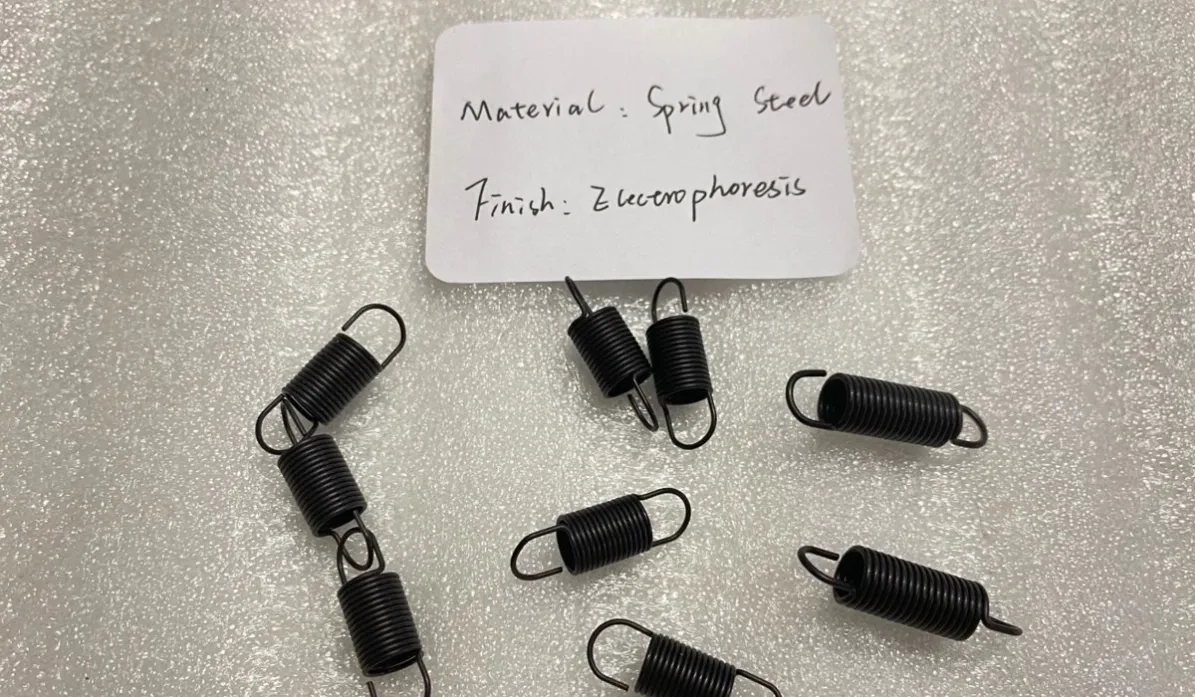
A spring is the part nobody redesigns until it fails — and then it is the only part anybody talks about. Instruments and equipment use custom springs because the standard catalog spring is the wrong rate, the wrong length, or the wrong end form for the mechanism in front of you. We supply custom springs — compression, extension and torsion — as part of the same one-stop work as the machined parts around them; our springs process piece covers how they are made. This page is the buyer's half: what a spring drawing needs to state so the spring you receive is the spring your mechanism was designed around.
The three types, briefly
Compression springs push back: they carry load in closures, plungers, detents and return mechanisms. Extension springs pull: they hold covers closed, return levers, and tension linkages, with loops or hooks formed at the ends. Torsion springs twist: they return hinges, clamps and flaps to position around a pivot. The type decides the drawing's key dimensions, which is why a spring is specified by its drawing and not by a photograph of the old one.
What the drawing must state
A spring is a rate, not just a shape. A complete specification gives the spring maker:
- Wire diameter and material — the wire is the spring's strength and most of its rate.
- Outside diameter (or inside diameter, if it fits over a rod) — and the space it must work in.
- Free length for compression and extension springs; leg positions and wind direction for torsion springs.
- Coil count — total and active coils, and for compression springs the end form (closed, ground, open).
- The working deflections and loads — the lengths (or angles) it works between, and the force expected at each. This is the line that turns a shape into a spring: two springs identical in every dimension but wound to different rates behave differently, and only the load specification says which one you meant.
- Finish — and the environment it works in.
If some of these are unknown — a replacement spring with no surviving drawing is the common case — send the sample or the mechanism's requirements and the specification can be worked out from the application; that conversation is part of the quote.
Materials and finishes
Carbon spring steel and 65Mn spring steel (comparable to AISI 1065) are the regular spring materials in our work, stress relieved after forming (or hardened and tempered, depending on the wire) so the spring keeps its rate. Stainless spring wire is quoted where the environment demands corrosion resistance. Finishes follow the service: black e-coat (electrophoretic coating) is a common one on equipment springs — corrosion protection with a clean, uniform appearance that suits instrument interiors — and oiling or plain finishes serve where coating build is unwelcome. The finish belongs on the drawing for the same reason it does on a machined part: a coating has thickness, and on a spring it slightly changes the working dimensions.
Springs arrive with the hardware they serve
The practical point of sourcing springs with the machined parts: the bracket, the pivot pin and the spring that returns it come from one drawing package, checked against each other, in one shipment — instead of three suppliers each assuming the other two held the tolerance. For instrument and equipment makers building in small batches, that consolidation is most of the value.
Send the spring drawing — or the sample and the mechanism's requirements — through our contact page. We respond within 8 hours and normally quote within 24 hours.
FAQ
What information do you need to quote a custom spring? Wire diameter, material, outside diameter, free length (or leg geometry for torsion), coil count and end form — and above all the working loads at the working deflections. Missing items can be worked out from a sample or the application; tell us what you have.
Can you copy an existing spring? A sample can be measured and reproduced, and its rate verified against the original. Where the original failed early, tell us — copying a failed spring exactly is sometimes the wrong job, and the specification can be adjusted.
Which spring materials do you work in? Carbon spring steel and 65Mn spring steel are the regular materials, stress relieved or hardened and tempered after forming, depending on the wire. Stainless spring wire is available on request for corrosive environments.
What finishes are available on springs? Black e-coat (electrophoretic coating) is common on equipment springs; oiled and plain finishes are also supplied. The finish is stated on the drawing, as coating build slightly affects working dimensions.
Can springs be supplied together with machined parts? Yes — springs, brackets and pins from one drawing package, in one shipment. That is how most of our instrument and equipment customers order them.