Custom Torsion and Extension Springs
When the catalog has no spring in your size, rate or end type, it becomes a custom part. Torsion and extension springs: what to specify, materials, finishes and quantities.
Nobody designs an assembly around the springs — until the standard spring catalog has nothing in the size, rate or end configuration the design needs. Then the spring becomes a custom part like everything else in the assembly: wound to order on a spring machine, heat treated, finished, and made in the same prototype and small-batch quantities as the machined parts it works with.
We supply custom torsion and extension springs alongside our machined and sheet metal parts — manganese steel torsion springs, spring steel extension springs with an electrophoretic black finish, and more. This guide covers the two types we are asked for most, and what actually needs specifying.
Torsion springs: it is all in the legs
A torsion spring stores energy by twisting: the coils wind tighter as the legs are deflected. Specifying one takes more than a diameter and a wire size:
- Wind direction. A torsion spring must be loaded in the direction that winds it tighter, never unwound. Left-hand and right-hand wound springs are different parts — state which you need, or send the mating part.
- Mandrel size. The inside diameter shrinks as the spring deflects. The shaft it rides on has to be sized for the loaded condition, with clearance, or the spring will grip the shaft and the torque curve goes wrong.
- Legs. Length, bend angles and the free position of the legs decide how the spring engages your mechanism. Legs are where torsion springs are customized — the coil body is the easy part.
- Rate and torque. Given as torque per degree of deflection, at a stated working angle. A spring specified only by size is a guess; a spring specified by torque at angle is a part.
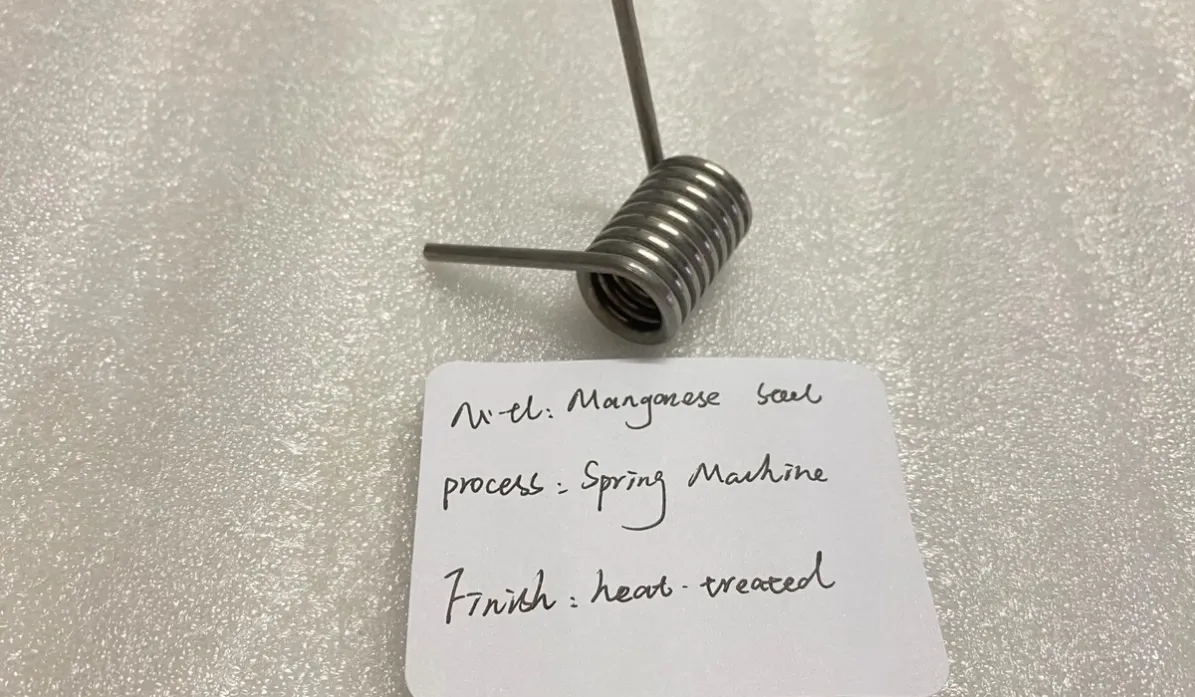
Our torsion springs, like the manganese steel example in the photo, are wound on a CNC spring machine and heat treated after coiling — stress relief that stabilizes the rate and keeps the spring from taking a set in service.
Extension springs: the hooks decide the life
An extension spring works in tension, pulled from its end loops or hooks — and the ends are where almost all extension spring failures happen. The coil body is a solved problem; the bend where the wire turns into a hook is a stress concentration, and it is the first place fatigue starts.
What to get right:
- End type. Machine loops, crossover loops, side loops and extended hooks all exist for a reason — how the spring attaches, and whether the load stays centered on the spring axis. An off-center pull bends the spring as it stretches and shortens its life.
- Initial tension. Extension coils are wound tight against each other, so the spring resists with a built-in preload before it starts to extend. That preload is part of the specification, not an accident.
- Working extension. Rate (force per unit of stretch) plus a sensible maximum working length. Springs stretched beyond their design range take a permanent set and come back shorter and weaker.
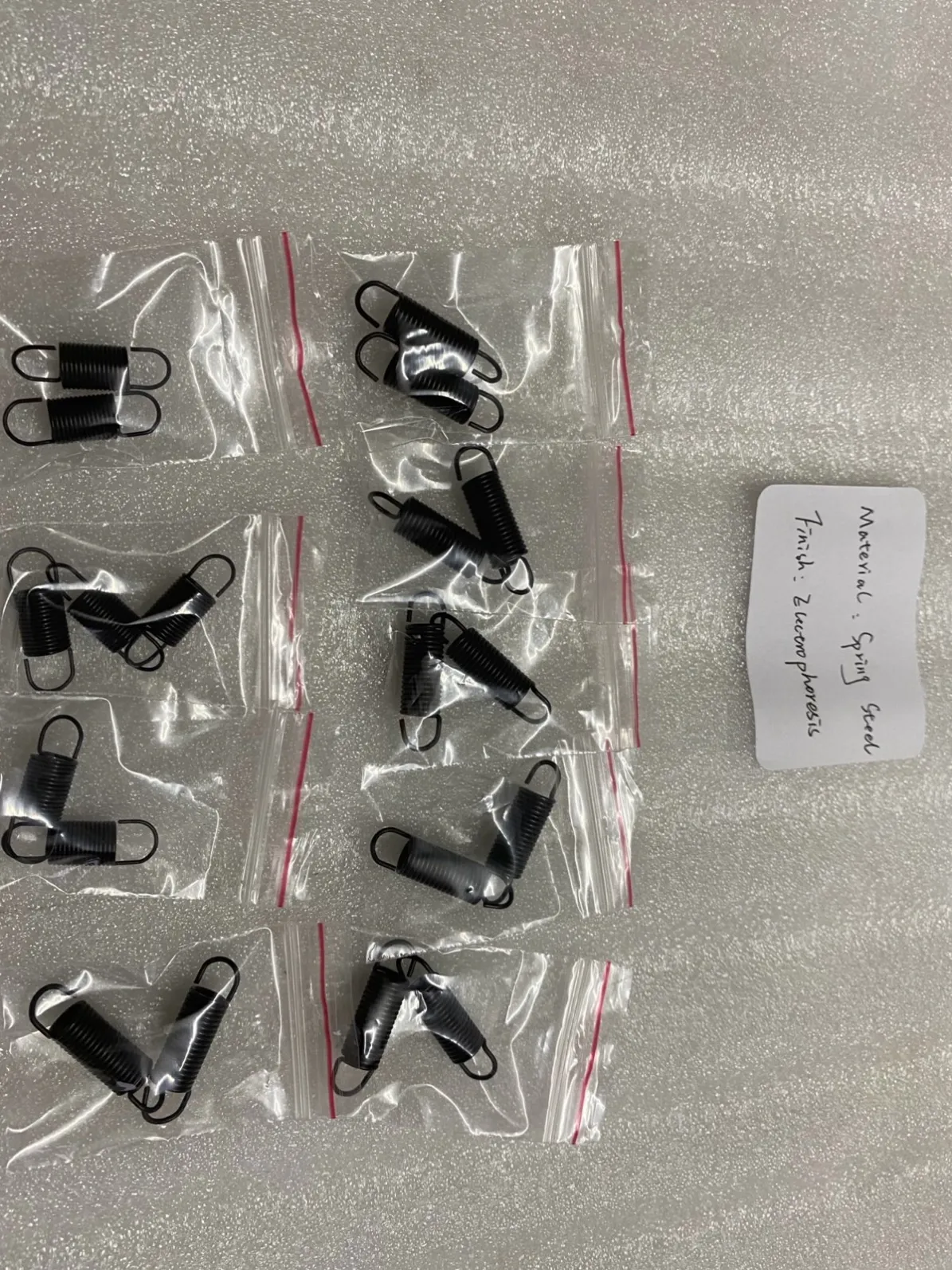
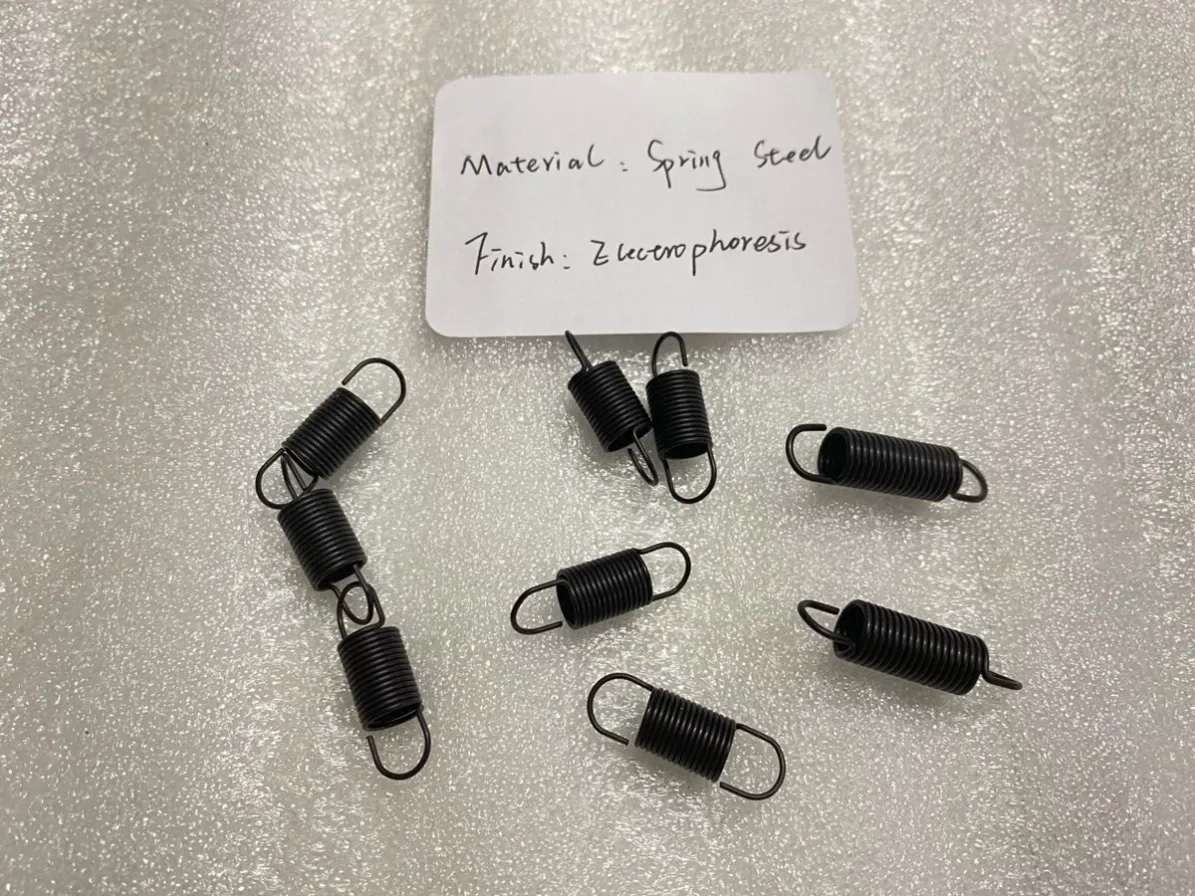
The extension springs in our photos are spring steel with an electrophoretic black finish — an even, corrosion-resistant black coating that covers the tight coil gaps a spray finish would miss, and the finish most equipment builders ask for when the spring sits inside a black assembly.
Materials and heat treatment, briefly
- Spring steels and manganese steel are the workhorses: high elastic limit, good fatigue life, the default for equipment springs.
- Stainless spring wire trades some strength for corrosion resistance where the spring works wet.
- Heat treatment after coiling — a controlled stress relief — is not optional on a serious spring. It stabilizes dimensions and rate, and it is the difference between a spring that holds its free length for years and one that relaxes in the first month.
Finishes follow the environment: electrophoretic black as shown here, or other protective coatings from our surface finishing range where the application calls for them.
What to send for a spring quote
A spring can be quoted from a drawing, a specification, or a sample. The useful information:
- Spring type (torsion or extension) and what it has to do — load or torque, at what deflection
- Wire diameter, outside diameter, free length (and body length/coil count if known)
- End or leg configuration — a sketch or photo of the mating parts settles this fastest
- Material and finish, if already decided
- Quantity — prototypes and small batches are normal for custom springs
Springs usually ride along with an assembly of machined parts, and that is how we prefer to supply them: the brackets, shafts and housings from our CNC machining shop and the springs that connect them, in one shipment, checked against each other before they leave.
FAQ
Can you make a spring to match a sample? Yes. A sample gives us the wire size, coil dimensions and end configuration directly, and we can measure its rate. If the original material matters, tell us what you know about it — samples plus a description of the duty is usually enough.
Why does wind direction matter on a torsion spring? A torsion spring only works loaded in its winding direction; loaded the other way it unwinds, loses rate and can slip off its mandrel. Right-hand and left-hand springs are mirror parts, not interchangeable ones.
Why do extension springs break at the hooks? Because the hook bend concentrates stress far above what the coil body sees. Correct end design, centered loading and not over-extending the spring are what keep the ends alive — the body almost never fails first.
What does the electrophoretic black finish do? It is a uniform, corrosion-resistant black coating that reaches into the closed gaps between extension coils, where spray finishes bridge or miss. It also keeps the spring visually consistent with black-finished assemblies.
Do custom springs need heat treatment? Yes — a stress-relief heat treatment after coiling. It sets the spring's dimensions and rate so they stay where they were made, instead of drifting as the spring works.
What quantities can you make? Custom springs are made to order, from prototype quantities up. Because they are wound on CNC spring machines rather than pulled from a catalog, small batches are practical — the same quantities as the machined parts they ship with.