CNC Turning vs Milling: Which Fits Your Part
Round parts belong on a lathe, prismatic parts on a mill — and many parts need both. How to tell which process fits, and where the limits sit.
Turning and milling remove metal in opposite ways. In turning, the part spins and a stationary tool cuts it; in milling, the part stays still and a spinning cutter does the work. That difference decides which process fits your part, what it costs, and how long it takes. Round parts belong on the lathe, flat and pocketed parts belong on the mill — and a large middle group needs both. This article walks through the three cases and the size limits for each.
Start with the shape, not the machine
If the important surfaces share one center axis — diameters, bores, grooves, threads, tapers — the part is rotational, and turning makes those surfaces round, concentric, and finished in one setup. If the important surfaces are flat faces, pockets, slots, and hole patterns spread across a block, the part is prismatic, and milling is the natural fit.
Stock follows the same logic. Turned parts start as round bar, and most of the bar stays in the part. Milled parts start as plate or block, and a round outline milled from plate wastes material and time at every corner.

When turning is the right answer
Turning is the process for shafts, pins, bushings, sleeves, flanges, and threaded fittings:
- Diameters and bores that must be round and on one axis — bearing seats, press fits, sealing surfaces.
- External and internal threads, cut in the same setup as the diameters they belong to, so the thread runs true to the bore.
- Grooves and undercuts for O-rings, circlips, and retaining rings.
- Faces and shoulders square to the axis, which flanges and mating sleeves depend on.
Turning is also fast. A simple bushing in 6061-T6 aluminum or a pin in 304 stainless steel takes minutes of cutting, and bar-fed lathes make small round parts in batches with little handling — the routine behind our batch turning of small parts. If your part is round, with no features off its axis, there is rarely a reason to mill it.
When milling is the right answer
Milling takes over as soon as the geometry stops being round. Housings, brackets, mounting plates, manifolds, and enclosures live on the mill, because their features point in several directions at once:
- Pockets and cavities — lightening pockets, recesses, internal channels.
- Flat faces and steps at different heights, often on several sides.
- Hole patterns whose positions matter relative to each other, not to a center axis.
- Contours and profiles — curved outlines and angled faces no lathe tool path can follow.
Angled holes, compound curves, and features on five sides are where 5-axis machining does the heavy lifting: the part stays clamped and the features stay accurate to each other. If your part looks like a block with work on more than one face, it is a milling part.
Parts that need both: mill-turn
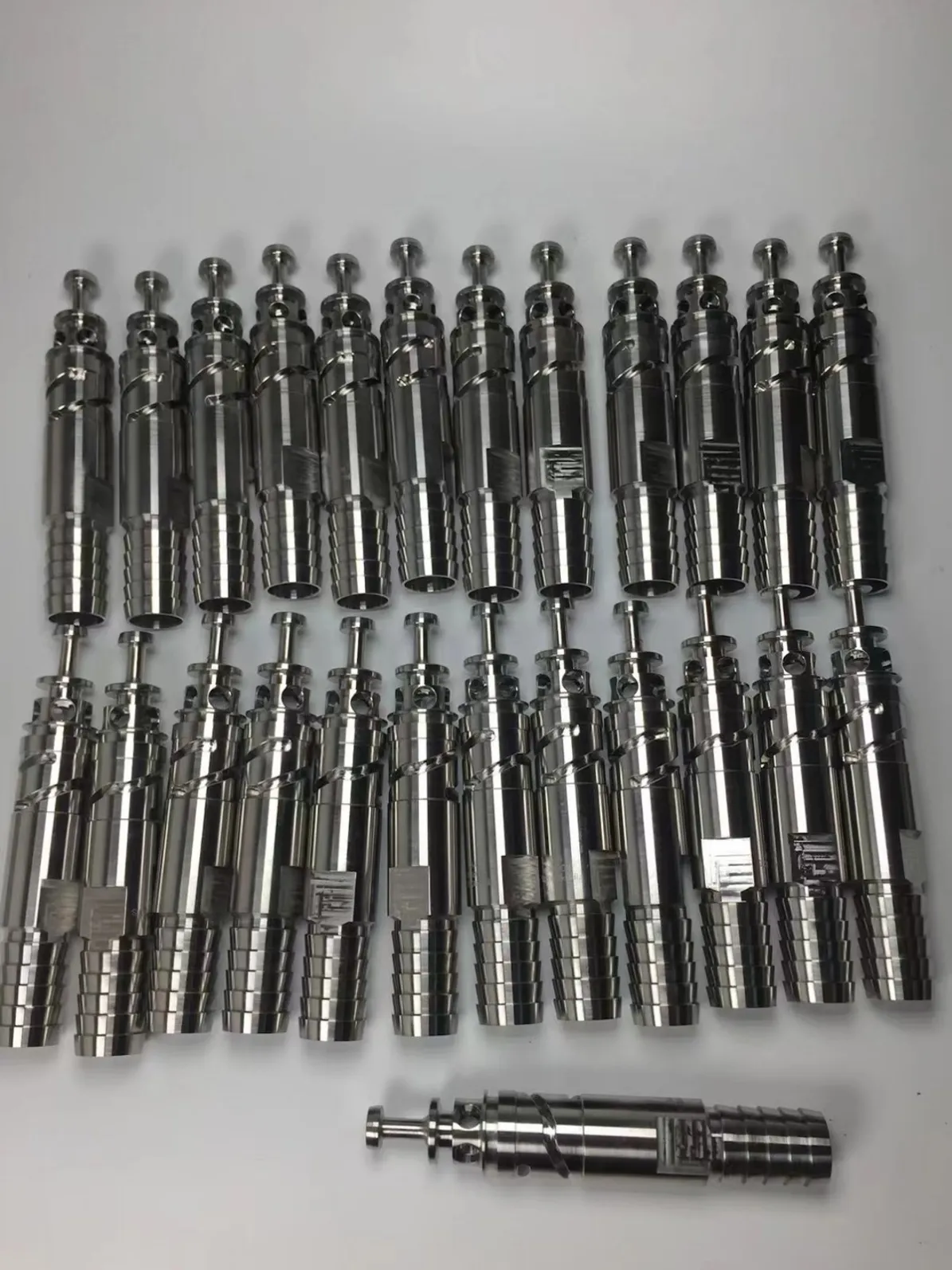
Many real parts sit between the two. The body is round, but it carries flats, cross holes, a hex, a keyway, or a pocket that breaks the round shape — valve bodies, sensor housings, drive hubs, and fittings with wrench flats, for example.
The older way is two setups: turn the part, then move it to a mill. It works, but every move costs time, and the milled features must be re-located from the turned datums — where small position errors creep in. The better way, where part size allows, is a mill-turn machine: a lathe with driven milling tools that finishes the milled features in the same clamping, on the same axis. Our article on turn-mill machining covers it in detail. Tell us which features are critical, and we route the part so they are made in one setup wherever possible.
The size limits that apply
- Turning: up to Ø250 mm (9.84") diameter by 200 mm (7.87") long — covering most shafts, bushings, and fittings.
- Milling: travel up to approx. 750 mm (29.5") in X — covering most housings, plates, and enclosures we see.
Parts beyond those numbers change the routing and the quote, so flag oversize dimensions early.
Tolerances: the same numbers, different strengths
Both processes work to the same headline figures in our shop: standard tolerance ±0.1 mm (±0.004"), with ±0.01 mm (±0.0004") achievable on the features that need it. They differ in what each holds most easily. Turning naturally holds tight diameters and concentricity, because everything is cut around one axis. Milling naturally holds flatness and hole positions across a face, because the part never leaves its fixture. A milled feature that must be concentric to a turned bore is exactly the case mill-turn exists for.
So put the tight tolerance on the feature that does the work — the bearing seat, the sealing face, the locating hole — and let clearance features run at standard tolerance. Tight everywhere costs more on either machine and gains nothing in service.
What to send for a quote
Send the 3D model (STEP is ideal), a 2D drawing with the dimensions and tolerances that matter, the material grade in full — 6061-T6 aluminum, 304 stainless steel, and so on — the quantity, and any finish. Inquiries are answered within 8 hours, quotes usually within 24 hours. Send your drawing through our contact page — we ship worldwide.
FAQ
How do I know if my part is a turning or a milling part? If the key surfaces share one center axis — diameters, bores, threads — it is a turning part. If they are flat faces, pockets, and hole patterns on a block, it is a milling part. Round with flats or cross holes means both.
Can a lathe make a square part? Not sensibly. A lathe can add small milled features to a round part, but a mainly prismatic part belongs on a mill from the start.
What is the largest part you can turn? Up to Ø250 mm (9.84") in diameter by 200 mm (7.87") long. If your part is larger, send it anyway — we will tell you at quote stage what route it needs.
Does milling or turning give a better surface finish? Both produce good machined finishes, and either can be refined where a drawing calls for it. Secondary finishes such as bead blasting apply equally to both.
My part needs both processes. Do I need to order them separately? No. Send one drawing and one order. We route the part through turning and milling — or a mill-turn machine in one setup — and you receive finished parts from a single quote.