Machining a Heatsink Enclosure: Fins, Fit, and Colored Anodizing
A heatsink enclosure is both the box and the cooling system. Machining fins and fits in aluminum, then finishing with colored anodizing that lasts.
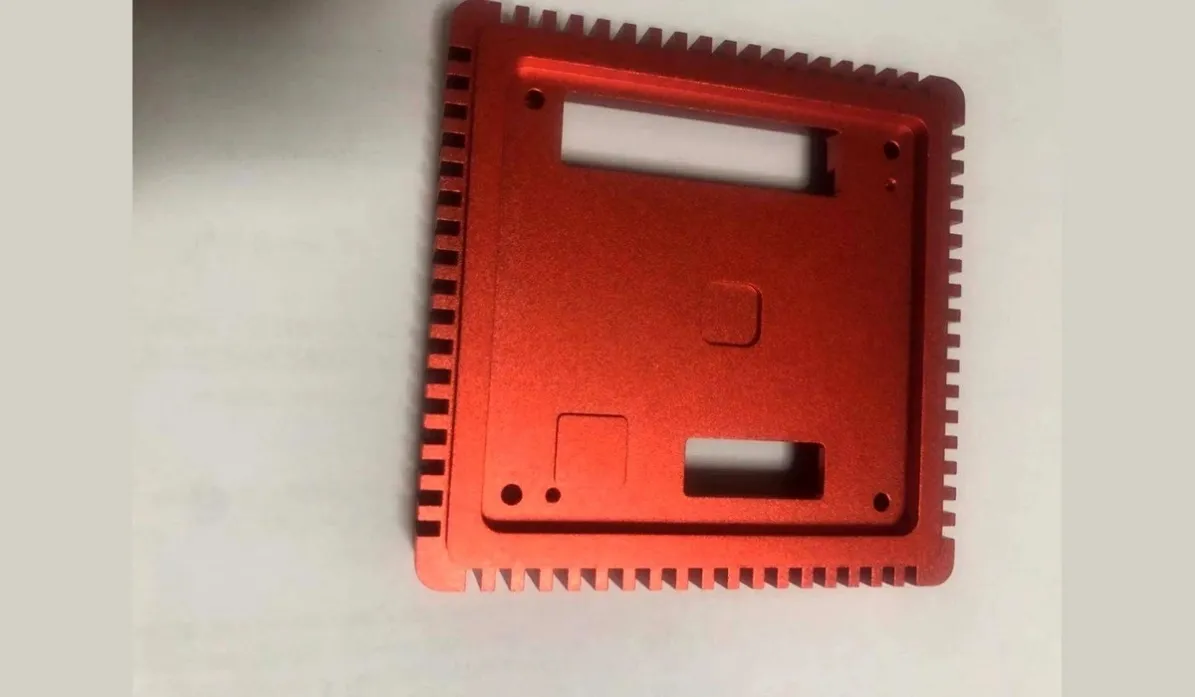
Some parts do two jobs at once. A heatsink enclosure is the box and the cooling system: it protects the electronics inside, gives them something to mount to, and pulls their heat out through its walls and fins. The red enclosure in the photo is a typical example — an aluminum housing with machined fins, finished in red anodizing.
Because the part is both structure and heat exchanger, it has to be designed and machined with both jobs in mind.
Fins Are a Machining Decision as Much as a Thermal One
On paper, cooling improves with more fins, thinner fins, taller fins. On a milling machine, fins are thin walls standing in a row, and each one wants to vibrate, deflect away from the cutter, and come out tapered. What actually gets built is a negotiation between the thermal design and the cutter:
- Fin spacing must fit a tool. The gap between fins has to admit an end mill with room to spare. As a practical matter, gaps under about 2 mm get slow and expensive; 3 mm and up machines comfortably.
- Fin thickness vs height. A fin that's tall and thin flexes under cutting load and rings like a tuning fork, leaving a poor finish. Keeping the height-to-thickness ratio modest — or accepting a slight taper — produces fins that are straight and clean.
- Machine from solid, or start from an extrusion? For prototypes and low volumes, machining the fin field from solid aluminum plate is usually the right answer: no tooling, any geometry, parts in days. Standard fin profiles at high volume may suit an extrusion that then gets machined to final shape. We'll tell you honestly which side of that line your quantities fall on.
The base of the enclosure matters just as much. The surface the electronics mount to needs to be flat and smooth where components or thermal interface material sit — that's a finishing pass and a tolerance callout worth making explicit on the drawing. Our standard machining tolerance is ±0.1 mm, with ±0.01 mm available on the features that need it.
Why Aluminum, and Which One
Aluminum is the default heatsink material for good reasons: it conducts heat well, it's light, and it machines fast. The common alloys split the difference differently — 6061 is the all-rounder with good strength and excellent anodizing behavior; higher-conductivity alloys exist for designs where every degree counts, and they trade away some strength and finish quality. For most enclosures, 6061 is the sensible default, and it's what we'd quote unless the thermal design says otherwise.
Colored Anodizing: More Than a Paint Job
The red on the enclosure in the photo isn't paint. It's anodizing — a hard oxide layer grown from the aluminum surface itself, dyed before sealing. For a heatsink enclosure it earns its place three ways:
- Corrosion protection for a part that often lives in warm, humid, or outdoor air.
- Electrical insulation on the surface, which can matter when a housing sits close to live components.
- Identity. A color-coded enclosure — red here — distinguishes a model, a voltage, or a brand at a glance, with a finish that won't peel, chip, or flake off the fins the way a coating can.
Two things to know about color anodizing. First, the finish under the color matters: we bead blast before anodizing as standard (a fine 120# media), which gives an even, matte surface that takes dye uniformly — the process is covered in our article on why we bead blast before anodizing. Second, color is matched batch to batch, but anodizing is a chemical process, not a printer: parts anodized together match each other exactly, and parts from different runs can vary by a shade. If a project needs multiple batches to match, tell us at the start and we'll manage the runs accordingly. The common specification for this kind of work is MIL-A-8625 Type II — our guide to anodizing specs explains the classes.
A detail customers are often relieved to hear: precision bores and threaded holes don't need masking for anodizing. The oxide layer is thin and controlled enough that fits and threads work as machined, so we don't charge you for fiddly masking on features that don't need it.
Designed Together, Quoted Together
A heatsink enclosure is a part where a ten-minute conversation at quote stage saves real money — a fin gap widened by half a millimeter, a base flatness callout placed where it matters, a color decision made before the first batch rather than after. Send your model through our CNC machining page and mention the anodizing color you want. Quotes come back within 24 hours, prototypes typically ship in 3–5 days, and FAI reports, material certificates, and a certificate of conformance are available. NDA on request.