Beryllium Copper Stampings in C17200
C17200 beryllium copper stampings — punched, bent and gold plated. Why this alloy is chosen for spring contacts, and what the process demands.
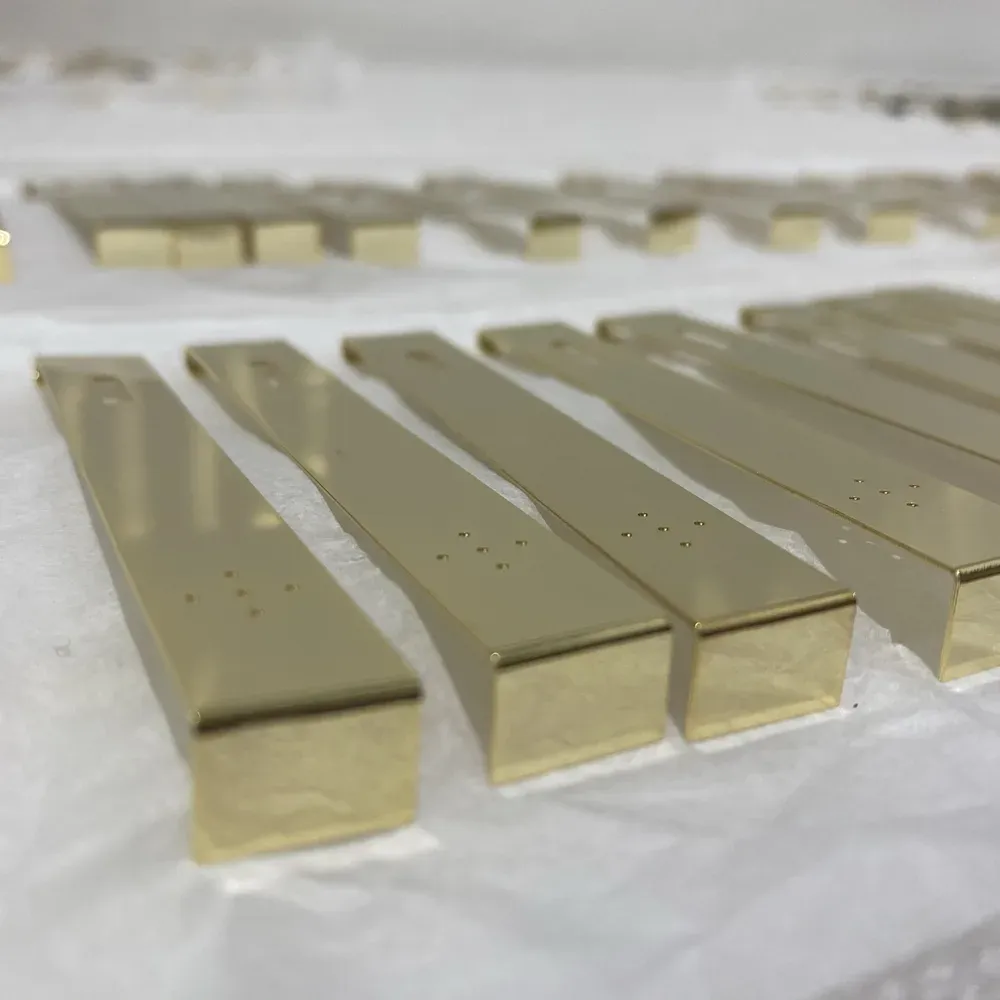
Some stamped parts are brackets. Some are springs that happen to be flat. The parts in the photograph are the second kind: C17200 beryllium copper, punched and bent to shape, then gold plated — small electrical contact parts whose job is to press, flex and conduct, thousands or millions of times, without taking a set or losing contact pressure. Beryllium copper is the alloy engineers reach for when a part must be a spring and a conductor at the same time, and it is a regular stamping material here. This page covers why it is specified, and what making parts from it involves.
Why beryllium copper, and not phosphor bronze or steel
The comparison every designer runs is against the alternatives. Spring steel is stronger per dollar but does not conduct and it rusts. Phosphor bronze conducts and springs respectably, but gives up strength. C17200 — the high-beryllium grade, roughly 2% beryllium in copper — closes most of the gap in both directions at once: after age hardening its strength approaches that of steel spring alloys, while its electrical conductivity stays in a range no steel approaches, and it does not corrode like either. Add fatigue resistance — the property that decides whether a contact spring still pushes back after its hundred-thousandth deflection — and the specification writes itself for contact parts, spring clips and connector elements that carry current. It is also non-sparking, which settles the question in a few specialized environments. The premium is real: the alloy costs several times what brass costs, so it is specified where the function needs it, not as a default. Our materials guide places it among the copper family.
Punched and bent — in that order, and in the right temper
The parts are produced by stamping: the profile and holes are punched from strip, and the forms — the bends that turn a flat blank into a spring — are made in the press tooling. Beryllium copper's working peculiarity is its temper path: depending on the drawing, parts are either formed in a workable temper and age hardened afterwards to reach full spring strength, or stamped from mill-hardened strip that needs no heat treatment after forming. Bend radii respect the material and the grain direction of the strip; a radius that brass would forgive can crack beryllium copper across the grain. This is die work with the material's habits designed in — the stamping route itself is the one on our sheet metal stamping page.
Gold plating: the working surface
The gold is not decoration. On a contact part, the surface is the product: gold does not oxidize, so contact resistance stays low and stable across years of service and thousands of mating cycles, where a bare copper alloy would slowly grow a resistive film. Gold also solders readily where a part must be terminated. The plating — gold, typically over a nickel underplate — is applied after forming and hardening, to the finished geometry, edges, bend radii and contact faces alike, to the thickness specified on the drawing. The parts in the photograph show the result: a uniform gold surface over a formed spring part. Other finishes in our range are compared in the sheet metal finishes piece; for contact duty, gold is in a class of its own.
What to send us
The drawing with the alloy and temper path stated (or the formed-and-hardened condition you require), the gold thickness, and the spring's working requirement if the rate matters — deflection and force, as with any spring. Quantities for stamped parts start where the tooling makes sense, and the quote will show that arithmetic honestly. Send it through our contact page; we respond within 8 hours and normally quote within 24 hours.
FAQ
Why is C17200 used for contact springs instead of brass? Strength and fatigue life. After age hardening, beryllium copper approaches spring-steel strength while conducting far better than steel and out-springing brass and phosphor bronze — and it does not corrode. For a part that must press and conduct for years, it is the standard answer.
Can beryllium copper be bent without cracking? Yes, with the process in the right order: parts are either punched and bent in a formable temper and then age hardened to full strength, or stamped from mill-hardened strip with no heat treatment after forming — the drawing decides. Bend radii are set for the material and the strip's grain direction.
Why gold plate a spring contact? Gold does not oxidize, so contact resistance stays low and stable over the part's service life, and it solders readily. The plating thickness is specified on the drawing and controlled to it.
Is beryllium copper expensive? Yes — several times the cost of brass, which is why it is specified where spring performance and conductivity are both required, not as a general stamping material. The quote itemizes material so the premium is visible.
What information does a quote need? The drawing with alloy and temper condition, gold plating thickness, quantity, and the spring's working deflection/force if the rate is specified.