Blog
What a Manufacturability Check Actually Looks At
Thin walls, deep pockets, tight corners, threads: what a manufacturability check actually reviews on your drawing before a part is quoted and scheduled.
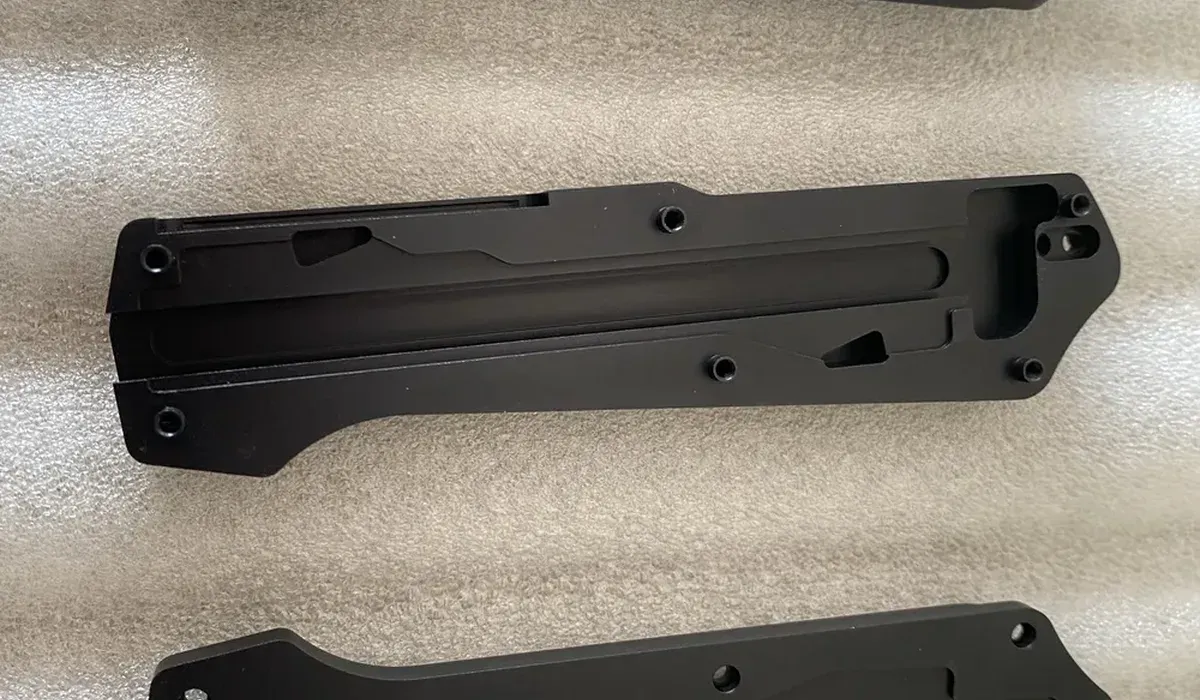
Every drawing that comes to us gets a manufacturability check before it's quoted and scheduled. Customers sometimes picture this as a quick glance — does it look machinable, yes or no. In practice it's a structured pass through the drawing, and it's where most production problems get caught while they're still free to fix.
Here's what we actually look at, and why.
Thin Walls
Thin walls are the classic CNC machining design trap. A wall that looks fine on screen can flex under the cutter, chatter, and come out wavy or out of tolerance. As a rule of thumb, metal walls under about 0.8 mm and plastic walls under about 1.5 mm need a conversation — sometimes the answer is a small thickening, sometimes a change in how the part gets fixtured, sometimes just an honest note that the feature will be delicate.
What we're checking isn't whether the wall exists in the model. It's whether it survives machining and still measures right afterwards.
Deep Holes and Deep Pockets
Drills and end mills are only so long, and they deflect more the deeper they go. A hole that's ten times deeper than its diameter, or a narrow pocket with a deep floor, pushes past what standard tooling does cleanly. When we see one, we check whether it's a through feature that can be machined from both sides, whether a standard tool reaches, or whether the depth-to-diameter ratio needs to come down. Deep features aren't impossible — they just shouldn't be a surprise halfway through the job.
Internal Corner Radii
This one catches people out constantly. A rotating cutter cannot make a sharp internal corner. Every inside corner of a pocket will have a radius at least as large as the tool that cut it. If a drawing shows perfectly square internal corners, something has to give: either the corner gets a radius, or the part goes to a slower, more expensive process. Adding a realistic radius at the design stage — the biggest your mating part allows — makes the part faster and cheaper to machine with no functional downside in most cases.
Tolerance Stack-Up and Over-Tolerancing
We read the tolerances as carefully as the geometry. Two things get flagged. The first is stack-up: dimensions chained together so that small errors add up and the final feature lands outside its limit even when every single cut was in tolerance. The second is a drawing where every dimension carries ±0.01 mm. Our standard is ±0.1 mm, and we hold ±0.01 mm where it's called out — but applying it everywhere multiplies machining and inspection time. We'd rather ask which dimensions are truly critical than quietly charge you for precision the part doesn't need.
Material Availability
A design is only manufacturable if the material exists in a usable form. We check that the specified grade is available in a stock size close to the finished part — an unusual grade or an oversized block can add days before machining even starts. If there's a lead-time problem, we'll say so at quote stage and suggest the nearest equivalent for you to approve.
What Happens When Something Won't Work
This part matters, so we'll be plain about it: we never change a customer's design. Not a dimension, not a radius, not a material. The design is yours.
What we do is explain, in writing, exactly what the problem is — "this wall will deflect," "this corner can't be cut as drawn" — and what change would fix it. The decision to revise is always yours. Sometimes customers come back with an updated drawing in an hour. Sometimes they tell us the feature is critical as-is, and we work out a process that handles it and price it honestly.
Why Ten Minutes of Checking Saves Weeks
Nearly every machining delay we've seen traces back to something a drawing review would have caught: a corner that couldn't be cut, a tolerance nobody needed, a material with a long lead time. Catching it before metal is cut costs a short email. Catching it after costs a scrapped part, a re-quote, and a slipped schedule.
That's the whole point of a design for manufacturability check. It isn't bureaucracy — it's the cheapest quality control in the entire process.
If you'd like a second pair of eyes on a drawing before you commit to it, send it through our CNC machining page. The check comes free with every quote, and if something needs attention, you'll hear it from us before it costs you anything.