Machining Large Plate Parts: Holding Them Flat and Getting the Holes Right
Large flat plates move when you clamp them — and again when you unclamp. Workholding and machining strategies that keep big plate parts flat and holes true.
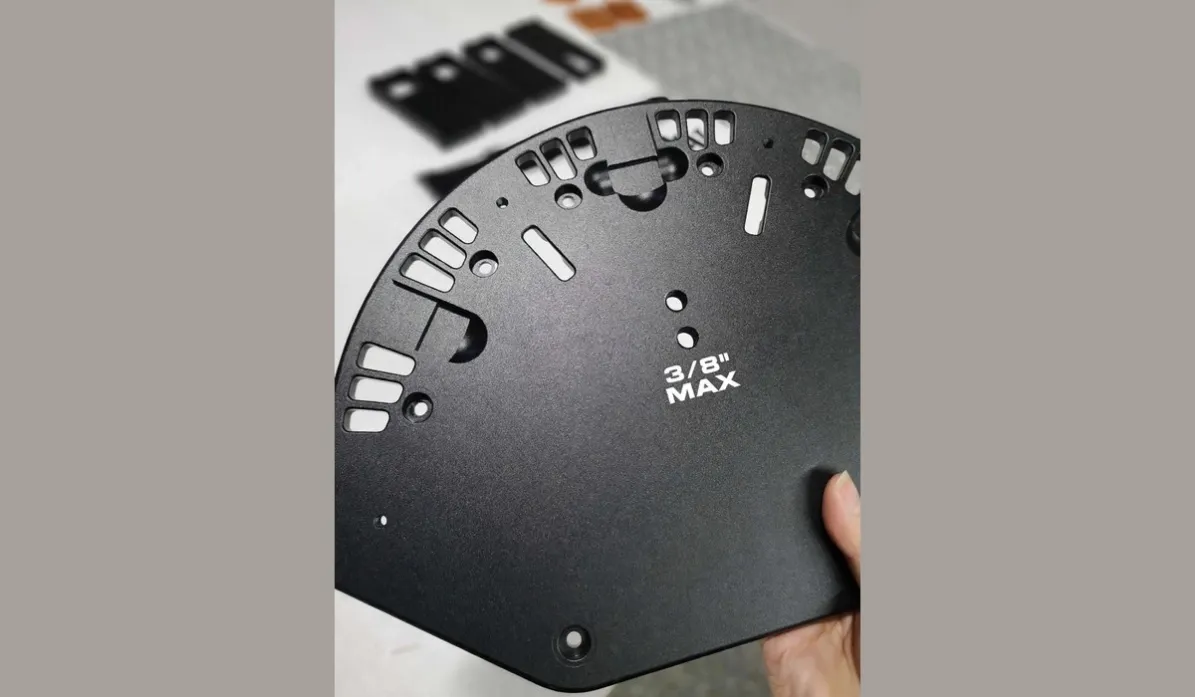
A large mounting plate — like the semicircular one in the photo — doesn't look like a difficult part. It's flat, it's not especially thick, and the features are mostly holes. Ask any machinist, though, and they'll tell you big flat parts have their own way of going wrong: they move when you clamp them, they move again when you unclamp them, and a hole pattern that's perfect at one end can drift out of position at the other.
Here's how we keep large plate parts flat, true, and on dimension.
The Real Problem: Stress and Spring
Plate stock carries internal stress from how it was rolled and cut. Machine material away from one face and the stress balance changes — the part bows, sometimes while it's still on the machine. Clamp it hard to force it flat and it simply springs back when the clamps come off, taking your flatness and hole positions with it.
The countermeasures are unglamorous and effective:
- Rough, release, finish. Heavy material comes off in a roughing pass, then the part is unclamped and allowed to relax before the finishing passes. Finishing a part that has already moved is how you get one that stays where you put it.
- Balance the machining. Taking similar amounts from both faces, in a sensible sequence, keeps stress release symmetric instead of letting the part curl toward the side you machined last.
- Support the whole part. Thin plates chatter and deflect under the cutter where they're unsupported. A vacuum chuck or a full-face fixture supports the plate everywhere at once — no clamp points denting edges, no unsupported middle drumming under the tool.
Workholding Without Distortion
How you hold a plate decides how flat it can be. Edge clamps on a thin plate create local pressure points; the surface between them is free to lift or bow by small amounts that don't matter on a bracket and matter a great deal on a mounting face.
For large flat work we favor vacuum workholding or low-profile fixturing that holds the part down across its whole footprint, with machining forces kept light on finishing passes. The goal is a part that is flat because it wants to be flat — measured free-state, off the machine, the way it will sit in your assembly — not one that was merely clamped into temporary obedience.
Hole Patterns Across a Large Span
A single hole is easy. Thirty holes spread across half a meter, all of which must line up with something else, is a different problem. Position error accumulates with distance, and temperature alone can move the far end of a large plate by a measurable amount between a cold morning start and a warm afternoon finish.
Our standard machining tolerance is ±0.1 mm, and ±0.01 mm is achievable where a drawing calls for it — but on large plates, the honest conversation is about which holes are truly critical. A pattern of locating holes that mates with another part deserves tight positional callouts and gets them; clearance holes for bolts passing through do not need the same treatment, and paying for it buys nothing. Our article on CNC tolerances walks through that logic in detail.
Where a plate carries precision bores — bearing seats, alignment features — those are finished in the same setup as the datum features they relate to, so position is established by the machine, not by a second setup's alignment.
Finishing and Handling
Big flat parts show every handling mark. A cosmetic face gets protected as soon as it leaves the machine, parts are separated in packing rather than stacked face-to-face, and edges are deburred all the way around — on a part this size, a forgotten sharp edge is a cut waiting for whoever unpacks it. Surface treatments like anodizing or powder coating are done in-house alongside the machining, so a finished plate ships as one part, not a relay race between suppliers.
Send Us the Plate You're Worried About
Large plates are exactly the parts where a quick review before cutting saves a remake: clamping strategy, which holes genuinely need tight position, whether the thickness you specified will stay flat. Send the drawing through our CNC machining page — quotes come back within 24 hours, prototypes typically ship in 3–5 days, and FAI reports, material certificates, and a certificate of conformance are available on request. We're happy to work under NDA.